Atheism VI

A friend of Hermitary wonders if the entries here on atheism too narrowly identify atheism with modern Western thought, science, and technology, when atheism has been a factor in many other cultures having little to do with science. Our focus has been on modern atheism, which is based on premises that a Socrates or Lucretius did not hold as either philosophical necessity or cultural compulsion. Modern atheism is, as Robert Thurman puts it in his Infinite Life, “nihilistic materialism,” which even the Buddha — mistakenly called an atheist by many Western religionists — rejected as an error.

Classical skepticism was not so much a militant belief against Zeus or Caesar but a mild shrug at folly, discernible in Stoics and Epicurians, still observable in the constructs of Descartes or the reflectiveness of Spinoza. But mildness is not a characteristic of modern atheism, with its teeming metropoli and its death camps, its nuclear and bio-chemical weapons, its raising of a Babel-like world culture. As our correspondent rightly points out, however, it should be emphasized that atheism has not been alone in creating these horrors. Christianity and its scriptural siblings have supported and extended these horrors, and some of the more articulate defenders of war and destruction are emphatically religious in that convenient identity, spinning off new justifications for distinctly modern and ungodly contrivances. Thus many Christians and their coreligionists have embraced science and technology (after sanitizing its moral ambiguities) and all the horrors that science and technology are capable of. And not merely the horrors but the drab and oppressive ways of modern culture so inimical to holistic life.

A skepticism of culture itself is what is in order, not merely of its epiphenomena, and this is where modern atheism fails. Instead it has enthusiastically embraced culture as a field of contention for struggle and triumph, or if unable to capture culture — like capturing the state — it has dissipated itself in nihilistic materialism. Where classical skeptics remained doubtful of social change and functioned more like solitaries in their personal lives, the cultures of atheism have been secular versions of the suppressive cultures they hate, mirrors of what they rival. Who, then, is Dr. Jekyll, whom Mr. Hyde? Neither one escapes complicity. Both sit disquietly in the seat of judgment, for are they not one person after all?

Disbelief in culture — even mere disillusion, like that of the hermit — is the beginniing of an affirmation of values. The potential of evolving an ethos may not involve a metaphysical component at all. In fact, it is here, in this state between what has historically been called theism and atheism, that the diversity of peoples and cultures can begin to find something in common.

What to die for

In George Bernard Shaw’s play Androcles and the Lion, the character Livinia is about to suffer martyrdom, and the Roman captain asks her whether she isn’t, after all, going to die for nothing. Lavinia, the Christian, does not respond with a stock answer of heroic bravado and passion, but with an answer full of quiet faith in her path, though not in this or that dogma. She is not dying for her dreams, she says, nor for wonder stories. Then for what? she is asked. “I don’t know,” she responds. “If it were for anything small enough to know, it would be too small to die for. I think I’m going to die for God. Nothing else is real enough to die for.”

Faith does not assume that we “know” God, or have mastered the ways of God. On the contrary, this would make God “too small.” However we define God is inadequate, of course, but we must live for this path to God, just as we must die for it.
Hermit’s mortality

In one of her colorful travelogues of early twentieth-century Tibet, Alexandra David-Neel tells of a hermit lama who received a bag of money from a benefactor to be used for provisions. The lama’s unscrupulous disciple stabbed his master with a knife and fled with the money. When visited by another disciple days later, the hermit’s wound was festering badly; he had bled a great deal and was weak. The hermit must have been in excruciating pain. But as in so many hermit stories of the east, the hermit insisted that the disciple not summon a physician because then the assailant would be sought and, if found, even be killed. The hermit hoped for time to let the assailant get away. The disciple was obviously concerned about the master’s condition. But the hermit told the disciple to go, adding, “When I meditate, I do not suffer, but when I become conscious of my body, my pain is unbearable.” A short time later, the hermit died of his wound.

Koans

Whatever we may think of various ways of reflecting on the future — turning up a card, consulting a celestial chart, or lighting a candle with a prayer — the fact that one is focused on the future is a tenuous practice. Focusing on the future works for practicalities, like appointments and due dates and business plans, but in resolving life’s true dilemmas, the future does not exist. We must gauge the sensibilities of the present, not predict the sensibilities of the future. The goal must be based on a realistic now, on the path’s first step, not on the endpoint. But too often the present is an emotional cloud, and we are prevented from being very effective concerning either the present or the future.

The koan has the ability to break through both these foggy states of present and future. Rather than try to assess the present fog and fight through it to the equally foggy future, the koan snaps us out of (or, rather, into) the present altogether. The koan does not give an answer or even hint at one as such. Rather, it is a tool for – to invent a verb – “presenting.” The koan is an honest shout of “Hey!” to the universe, and to one’s own morose ambivalence, demanding a new look, a fresh perspective, and not even an answer to the koan’s question. The koan is akin to modern notions of asymmetrical association in psychology, where something startles us out of our preoccupations with the non-existent future and the dissipated present to make this moment worth it.

Bears again!

A sure sign of spring around the “Hermitary” is the reemergence of bears, in this case, an adult female and her three cubs. Perhaps this is the same mother bear from Spring 2003 (see photos in Features), or perhaps one of her daughters, or perhaps newcomers altogether. But they have occupied the same dry slough behind the wooded area, and make the same regular trek to investigate birdseed and water sources around the house. The cubs are as small as puppies, and at the first sign of danger, the mother grabs each by the scruff of the neck and they scurry away from frightening sounds like motors. Sadly, the neighborhood here, once semi-rural, has suffered discovery as an exurbia. There are many more houses, many more trees felled, more noise and other pollution. One wonders how the bears persist, but I suppose the same question can be directed to oneself.
(New bear photos coming soon.)

Burrough’s chatter

Beat generation writer William Burroughs broke with his compatriots in not being enamored with Buddhism. Burroughs was once persuaded — in 1975 — to attend a retreat with the famous Chogyam Trungpa and loathed it. First he wanted to bring a typewriter but the request was turned down. So he took concealed paper and pencil. He insisted on recording his every thought and dream. Burroughs argued that he did not like Buddhism’s closed and predictable system of karma and rebirth, and preferred instead the open system of Don Juan in the Carlos Castaneda books. In that system, the individual is like a warrior cutting a path through unpredictable obstacles, there being no “final solution or enlightenment.”

I’m not sure all Buddhists would agree with Burrough’s dichotomy. In any case, he is not so independent of his culture as he might imagine. Burroughs’ creativity is as much the journalist’s and diarist’s less the artist’s, meticulously recording what goes on around him, including everything that goes on in his mind. Self-perception is inflated to the status of a raging warrior’s combat against the universe. It reminds me of what one of the characters in a beat story objects to about meditation, about its silencing all the chatter in the mind: “But I like all the chatter.”

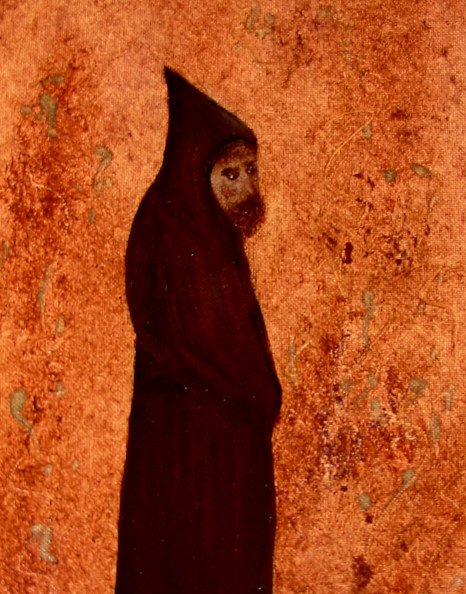
Ann Lang’s inner hermit

inner hermit
This icon portrait of a hermit is a glimpse of the inner hermit, says the painter Ann Lang. The hermit and seeker is within the psyche of each of us. The portrait invites reflection on what that inner hermit in all of us really is. Does the hermit represent or symbolize something other than that primordial search for solitude? Is it childhood reverie free of immediate (but not ultimate) authority (a la Freud)? Does it invite us to acknowledge the growth of self that can still be attained regardless of age or vicissitude (a la Jung)? Perhaps it reflects the perennial sense of freedom and harmony that all hermits seek: a little austere like the tarot hermit, not so self-consciously deferential as the institutional monk. He is diverted or distracted from his path by our interruption, our questioning presence. His glance waits for our question, or waits for our reply, or wonders why we speak (or don’t speak) at all. But having run into him, we now know he is lurking in this edifice, and we wonder when he will manifest himself again.
— Image sent to Hermitary by the artist.

Samuel Barber: Hermit Songs

Hermit Songs are poems translated by various hands from Old Irish texts and set to music as lieder by the American composer Samuel Barber (1910-81). One can easily be content with the text alone, as in the following poem. (Thanks to a friend of Hermitary for recommending them.)

The Desire for Hermitage
Ah! To be all alone in a little cell
with nobody near me;
beloved that pilgrimage before the last pilgrimage to death.
Singing the passing hours to cloudy Heaven;
Feeding upon dry bread and water from the cold spring.
That will be an end to evil when I am alone
in a lovely little corner among tombs
far from the houses of the great.
Ah! To be all alone in a littie cell, to be alone, all alone:
Alone I came into the world
alone I shall go from it.

Silence

The wind blows through the trees from one end of hearing to the other. As suddenly as it blew, the wind abates, and a palpable silence emerges, as if always there but concealed among the treetops. I want to take the silence like a jewel, place it on my forehead, let its glow suffuse my mind. I want to hold the silence like a bird, delicate, in the palm of my hand, but it eludes my grasping. It wants to be free, to fly as it will, and I am loathe to restrain it. In the darkness, the wind picks up again. Far away a dog is baying. I wait for a bird-cry but there is none. The night is moonless, but I can see my empty hands. Silence folds and unfolds as it will.

Illness II

When we are ill, we feel trapped by our body in a rigid zone of pain and malaise. The body which we so carefully cultivate for others and for our vanity betrays us. It leaves us helpless and asea.

Is sickness inevitable, like the cycle of seasons that revolves many times for our learning, or the cycle of life itself, which only revolves once and inexorably? According to some, each illness debilitates us in a pattern of revising genetic code. Our body remembers its vulnerability, like an old and unresolved temptation, and knows how to betray us when the near occasion arises again.

The metaphor seems far-fetched, yet from a biological point of view we are a bundle of delicate chemical interactions, complex yet predictable. The body is many times smarter than ourselves when it comes to the arbitrariness of our personality, our intelligence, our poorly-honed spiritual sensibilities. We astonish ourselves when these human characteristics work well — we call it synchronicity, more ambitiously a tapping into a collective consciousness, or even a kind of mysticism. But sickness can yield this same strange insight. The abandonment by the body, the thrust into affliction that is the counterpoint of beauty, can also provide us a moment of insight. How many classic mystics have suffered a physical affliction? “Malheur,” as Simone Weil called it, is “the only way that the human creature can re-create itself.”