
Wabi and Sabi: The Aesthetics of Solitude
Taoist and Zen Buddhist Aesthetics
Almost all the arts in China and Japan derive their aesthetic principles from Taoism and Zen Buddhism. These two philosophical systems proved compatible with the culture and psychology of the two great civilizations. The hallmark of a masterpiece of Chinese or Japanese art continues to be the naturalness and uncontrived, even "accidental" appearance of the piece. The highest achievement of Taoist and Zen art is produced by the individual who works with and harmonizes with nature and its universal accidents.
Wabi and Sabi
The two dominant principles of Chinese and Japanese art and culture are wabi and sabi. Wabi is literally poverty, but here it refers not to the absence of material possessions but to the non-dependence upon material possessions. Wabi is a divestment of the material that surpasses material wealth. Wabi is simplicity that has shaken off the material in order to relate directly with nature and reality. This absence of dependence also frees itself from indulgence, ornateness, pomposity. Wabi is quiet contentment with simple things.
Sabi is literally solitude or even loneliness. This is the atmosphere of the best Tang poets of China and haiku of Japan. Where wabi is material non-dependence, sabi is non-dependence in a psychological and spiritual sense. It rejects all contrived attachments in favor of reality and nature. Sabi involves imbalance and asymmetry in order to avoid contrivance, a rejection of the abstract and intellectual. Like Zen, sabi emphasizes the completeness of simple, even primitive experiences (moon-gazing, gardening, the tea ceremony) and objects (food bowls, tea cups, braziers, brush-stroked calligraphy, bonsai). There is utter grace in the execution, but a deliberate roughness or antiquarian primitiveness bordering on imperfection and lack of sophistication.
Seven Aesthetic Principles
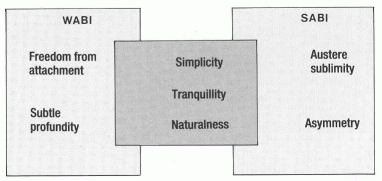
Borrowing from Peter Chan's introduction to Master Class Bonsai, seven aesthetic principles can be derived from wabi and sabi. The three core principles are simplicity, tranquility, and naturalness. Simplicity is application of the minimum and the appropriate. No more than these is ever needed, yet a profundity of aesthetic experience results. Tranquility suggests the quality of feeling refreshed and touched within, but with solace and calm, not excitement or over-stimulation. Naturalness is at heart the avoidance of contrivance. The artist attempts to make the artwork appear to have always been part of nature, as if no human intervention ever took place. The object (a garden, a path, even a fence) seems to have been a propitious result of natural accidents.
From wabi come two core principles: non-attachment and subtle profundity. Non-attachment gives the work its fresh and original feeling. The object is somehow familiar but does not depend on anything else. Subtle profundity is the notion of depth. Chan calls it the "intimation of inexhaustibility." The term inexhaustibility is better than Wordsworth's "immortality" for here the object resounds within us and itself with endless possibilities and nuances, at once hidden and successively revealed.
From sabi come two core principles: austere sublimity and asymmetry. Asymmetry rejects symmetry in form and balance in order to conform to nature. It is a balance of object against space, of place and proportion. This is the opposite of historically Western aesthetics, where painting, music, and poetry all conform to an almost mathematical prescription for symmetry. Austere sublimity reduces the object and its context to the essential. All non-essentials burden the viewer and interfere with the aesthetic experience, so that the object, now bereft of the superfluous, conveys the sublime. This is minimalism but with a strong emotive element.
Here is Chan's graphic illustrating the relationships of the aesthetic
principles:
With these aesthetic principles in mind, pursuers of solitude can better judge what will complement mind and heart, what to pursue in poetry, music, literature and thought.

BIBLIOGRAPHICAL REFERENCES
- Chan, Peter. Bonsai Master Class. New Yorl: Sterling, 1988.