
The characteristic of a gate is that it swings back and forth but is never permanently shutting the observer out of viewing one side or another. Perhaps it is locked but we can see through it. A door, in contrast, shuts, and we cannot see what is on the other side. Hence the wisdom literature always speaks of the gate, seldom of the door — except, perhaps, to show how we do not know what is on the other side of some experiences. “Knock and it shall be opened” suggests that we are not sure what is on the other side of the door, that we do not know what to expect, that we are hoping for the best. Knocking on a door involves trepidation, anxiety, uncertainty. Like a child in a dark house, we need reassurance that what is behind the shut door is benign. Will the experience we are soliciting or pursuing (“knocking” on) be what we want or hope? Who can tell? This is called faith.
Gates
The gate is a universal metaphor. In the Gospels, Jesus speaks of the narrow gate, and refers to himself as the gate. The Lotus Sutra speaks of the gate of knowledge as being difficult to enter. In the Koran, Muhammed describes himself as the city of knowledge and Allah as the gate. And Zen points to the “Gateless Gate.”
The ultimate gates are birth and death. Birth is literally a difficult passage for the “traveler” who would enter the world, and life is a search for easy gates to one temporal state or another, often distracted from the necessary end, which is to learn how to recognize the final gate.
The image of the gateless gate suggests that our anticipation, preparation and study may not get us to the expected gate. Events may change our minds, blind us to the road before us, mislead us down a fruitless path. The gate, like death, like life, is before us right now. We have but to enter it and abide in the place we have accessed, finding in the end that it is the same place from which we entered.
Demons within
Why do we not see the banal evils of society and culture (and of our own mundane selves) as the norm, and view creative breakthroughs and inspiration as the product of “daemons”? Instead of the historical view of demonic infestation as the source of evil in ourselves and the world, we can view the affairs of the mass of humanity as a pool of ignorance, and the leap of faith and love as something beyond ourselves, beyond that pool. Perhaps we should claim no more merit to ourselves for successful works of art, music, literature, charisma, love, or other creative feats than we want to take credit for the mundane sins, shortcomings, and ignorance that mark our lives. Brilliant insights are as much the work of harmonic wonder, grace, and “good karma” as sins and evil were viewed in the past as the work of disharmonic demons.
The desert fathers knew that a practiced hermit could make their infestuous demons disappear with a snap of the fingers. But reversing the metaphor also means that our cumulative individual progress can disappear in a moment, too, leaving the shell of a common person, nobody special, just another person trying to cope with their particular bundle of psychological and experiential baggage. Or worse.
The solitary has the opportunity to realize that he or she is not the source of what is good in them nor what is bad. The solitary can avoid the occasions of bad “infestation” by avoiding their source: society and culture. Only then can the good “daemons” begin to operate in one’s being, gently, with simple insights and quiet revelations.
Demons without
Demonic infestation — the presence of bothersome demons — is common in the writings of historical Christianity, Mahayana Buddhism (especially Tibetan), and most other traditions. The assumed ontology explains psychological phenomena, especially those related to behavior and morals, and always as negative. In monastic circles and among the sayings of the desert fathers, any sin or a temptation to sin was often viewed as demonic in nature.
A world, a sky, infested with demons is a pitiless view of nature.
But perhaps it was less terrifying to think of evil as the product of outside forces than of the darkness of human hearts. We have witnessed horrors enough in society and culture to wish that humans are merely tricked into evils and have nothing to do with them otherwise
Hermits in Literature: Ellis Peters
The Brother Cadfael mysteries of Ellis Peters are benign fun, but The Hermit of Eyton Forest disappoints a little because of the nearly complete absence of the title character, who turns out not to be what he is supposed. The hermit Cuthred appears suddenly as a pious pilgrim of few words.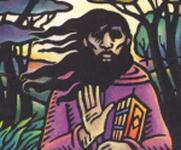 He follows Rotha Mary Clay’s textbook, mixed with a little eighteenth-century ornamental eremitism, occupying a hermitage on estate grounds, soon consulted by the whole countryside. His cottage has inner and outer rooms, the former including his bed, the latter an altar with candles and missal, before which he spends many hours. In true hermit fashion, Cuthred takes on an errant youth to run errands. And the populace attributes the halting of a cattle murrain to his prayers. Modesty is balanced by fame, the latter “went about by neighbourly whispers, like a prized secret to be exulted in private but hidden from the world.” For all that, the hermit is seldom featured, invisible throughout the mystery until the story’s climax. But at least Peters gives us a stock medieval prop, complete with the roguish ambiguities suggested by medieval history and lore.
Surowiecki on crowds
So brazen a title as The Wisdom of Crowds, a recent book by James Surowiecki, was bound to attract my attention, especially the presumptuous subtitle: “Why the Many are Smarter than the Few and How Collective Wisdom Shapes Business, Economies, Societies, and Nations.” The book is a miscellany of “fun” statistics, probabilities, and anecdotes. The author is a business writer and we soon see that his pen is guided by the supposed invisible hand of the market to offer a paean to commerce and consumption. No mention of psychology, values, individuality, alienation. Only the wonders of science, technology, and capital. The “wisdom” of crowds is merely that not too many people think for themselves beyond what they will consume today.
“People … can coordinate themselves to achieve complex, mutually beneficial ends even it they’re not really sure, at the start, what those ends are or what it will take to accomplish them. As individuals, they don’t know where they’re going. But as part of a market, they’re suddenly able to get there, and fast.”
Joshu and the hermits
The koan about Zen master Joshu meeting two hermits goes like this:
Joshu came upon a hermit’s hut. He leaned in and called,
“Anyone here? Anyone here?” The hermit raised his fist. Joshu said, “The water is too shallow to anchor here” and went away. He then came upon another hermit’s hut, where again he called out, “Anyone here? Anyone here?” This hermit, too, raised his fist. Joshu said, “Free to give, free to kill, free to save,” and he made a deep bow.
So what is the point? There are many commentaries on this koan, none definitive. We can say that we know nothing about the respective merits of the two hermits, no clue to suggest that one deserves to be called shallow and the other is worthy of a bow. I think (tentatively, of course) that it tells us more about Joshu, his realization that he can pass judgment arbitrarily (“free to give” etc.). This realization can be used by us arbitrarily, and hence without significance on what is reality. Hence he bows, having discovered it through the particular person in front of him, though who it is would not have mattered. Joshu must find what it is that enlightens or empowers he himself. Perhaps his bow is a form of repentance for realizing what he had not articulated to himself before. Or perhaps it is an absurd game of the hen looking for a place to lay its egg. It does not matter where, only to just do it.
Joshu commends the eremitical life either way: sometimes we are too shallow, and sometimes we are worthy. Only, let us not be the one to decide. If Joshu were to see us right now, which comment would he give us? And, frankly, wouldn’t either one be correct?
Frog mirror
Two frogs lie opposite one another on the window pane. Each is a less than a thumb’s length (well, my thumb), a shimmering green with dull yellow eyes, always in a half-doze. They are not exact images, one being attached to the window a few inches to the left (or right, depending which), yet they look at one another’s semblance of their undersides, as if within a strange malleable mirror distorted by space but not time. As night enfolds this little scene, space separates the little halves, and time itself disappears. No revelation, no insight, no frog plopping into a pond, a la Basho. The light withdraws from the mirror, and I can only wonder where these little creatures have gone, until tomorrow, when they reappear again in the magic mirror.
Krishnamurti on the solitary
In a 1955 talk entitled “Can We Create a New Culture?” the philosopher J. Krishnamurti explores the need to transcend the conventions of the various cultures and societies into which we are socialized in order to achieve a break-through to knowledge, truth, and a positive change in world and civil affairs. The passage on how this affects even the solitary is a provocative one:
Can the man who belongs to society — it does not matter what society — ever find truth, God? Can society help the individual in that discovery, or must the individual, you and I, break away from society?
Surely it is in the very process of breaking away from society that there is the understanding of what is truth, and that truth then creates the ripples which become a new society, a new culture. The sannyasi, the monk, the hermit renounces the world, renounces society, but his whole pattern of thinking is still conditioned by society; he is still a Christian or a Hindu, pursuing the ideal of Christianity or of Hinduism. His meditations, his sacrifices, his practices, are all essentially conditioned and, therefore, what he discovers as truth, as God, as the absolute, is really his own conditioned reaction. Hence, society cannot help man to find out what is true.
Csikszentmihalyi on solitude
In his book Flow: the Psychology of Optimal Experience(1990), Mihaly Csikszentmihalyi notes that good interpersonal relationships bring “flow experiences,” a high quality of life and happiness, but relationships involving conflict are probably the most depressing and dispiriting events anyone experiences. Yet, he notes, most people never explore solitude.
Why is solitude such a negative experience? The bottom-line answer is that keeping order in the mind from within is very difficult. We need external goals, external stimulation, external feedback to keep attention directed. And when external input is lacking, attention begins to wander, and thoughts become chaotic — resulting in the state we have called “psychic entropy.”
Hence the modern cycle of television, drugs, videos, games, shopping, overeating, sex, gambling — what become desperate methods for imposing external order on a chaotic mind. A positive solitude, however, is too difficult in Csikszentmihalyi’s scheme; he has only the goal of “flow” to offer, having written his book before the positive breakthrough of Anthony Storr’s Solitude and other books in rehabilitating the positive role of solitude.