Emerson’s good-bye

Society seems to pursue a biological imperative. People follow a track of survival and socialization that mimics basic animal instincts to reproduce themselves, their ideas, their culture — at an urgent, even frenetic (seen from a long view) pace. In one of his lectures, popular philosopher Alan Watts said that seen from a distant planet, the Earth would look like a series of organisms which, upon daylight takes in through its ganglia liquid nutrient, and then after a time disgorges it — always in a sequence, every 24 hours. Such is the world, specifically the modern technological world.

To get out of this as an individual is an enormous task, ultimately perhaps futile. Escaping it means not so much criticizing technology and structures around us, though we must preliminarily. More deeply it means rebelling against all animal instinct, including the comfort of survival taken for granted in the material conditions of society. We do not need merely food, shelter, and transportation to survive but depend on a network (a ganglia, to use Watts’ image) to supply these needs regularly, dependably, and in a psychologically satisfying way. This means “buying into” the structures of socialization, accepting the facelessness that is part of the social contract of technological society in exchange for survival and assigned peripherals. Who can gather the spiritual and psychological resources to break from this network? And, if it is not possible or feasible, how can one live with insight and wisdom without madness?

Simplicity provides a path for disengagement in the material sense of consumption (whether of food, popular culture, or socialization), but deeper mental resources are needed to make the individual disengagement that brings contentment and not mere sustainability. Although we may reach a point of pride in our ability to gain material sustainability, most people must work, pay bills, care for their children or elders, maintain their possessions, stay healthy, etc. Only the historical hermits have reached a point of equanimity in renouncing all of these animal concerns. Only the spiritual-minded have reached a point where they can accept what comes without resentment, guilt, or memory.

We may speculate that one who is not psychologically or physically prepared for the rigors of eremitism may end up reverting to a worse animality than that of the cog in society, True animals, of course, can do this — the lab-bred animal is much better off in the wild, but its instincts have been destroyed and now it is a mere organism, trapped between a laboratory prison versus probable inability to survive in the wild, a wilderness increasingly being destroyed anyway. Can a hermit expect better? Can we put our mental and psychological resources to work to solve this conundrum?

Emerson’s famous poem “Good-bye” expresses an attempt to disengage from the world while still taking with oneself the book-learning reflectiveness, the positive example of others (dead or living) and the survival skills of food-growing and shelter-making. How much of the latter tactile skills he had — Emerson, or his colleague Thoreau — is another but fascinating angle to the issue of social disengagement, one about which the historical hermits have much to offer. True enough that once we have taken formal knowledge and seasoned it with reflection, then nature will do its work to further refine reflection into wisdom.

But does it require Emerson’s intellect in order to get to this point, Emerson’s social status and (let’s be frank) wealth or comfort in order to have something to fall back on in case the adventure doesn’t work? Or can we go farther and give that up, too, like William Blake or Leon Bloy, the artists-poets, living in perpetual poverty who nevertheless doggedly carried on their creativity to the end? They lived in society, in the very midst of it, yet their rebellion was more of the character of a sophisticated engagement rather than a physical disengagement and disappearance. Thankfully, for us, we are able to see and read the products of such creativty. Yet do we not long to get creativity directly from nature, to mollify the pain and sorrow inflicted by the world, to say good-bye to it, once and for all?

The spirit (heart, soul, consciousness, mind) is willing, but the flesh — the animal instincts for survival, a niche, compatibility with others — is our downfall.

Here is Emerson:

Good-bye, proud world, I’m going home,
Thou art not my friend, and I’m not thine;
Long through thy weary crowds I roam;
A river-ark on the ocean brine,
Long I’ve been tossed like the driven foam,
But now, proud world, I’m going home.

Good-bye to Flattery’s fawning face,
To Grandeur, with his wise grimace,
To upstart Wealth’s averted eye,
To supple Office low and high,
To crowded halls, to court, and street,
To frozen hearts, and hasting feet,
To those who go, and those who come,
Good-by, proud world, I’m going home.

I’m going to my own hearth-stone
Bosomed in yon green hills, alone,
A secret nook in a pleasant land,
Whose groves the frolic fairies planned;
Where arches green the livelong day
Echo the blackbird’s roundelay,
And vulgar feet have never trod
A spot that is sacred to thought and God.

Oh, when I am safe in my sylvan home,
I tread on the pride of Greece and Rome;
And when I am stretched beneath the pines
Where the evening star so holy shines,
I laugh at the lore and the pride of man,
At the sophist schools, and the learned clan;
For what are they all in their high conceit,
When man in the bush with God may meet.

Holy hermits

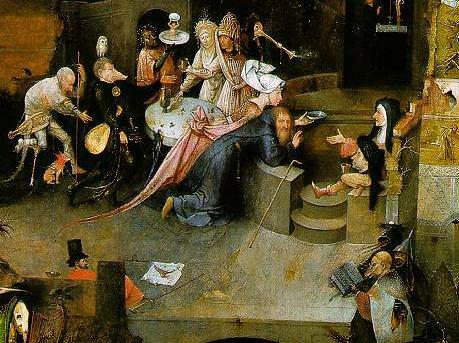
With Jan Van Eyck, we are on more conventional territory than the mad Heironymous Bosch in the portrait of hermits (see previous post). Bosch was engulfed in a millenarian contagion of madness and portrays the shift in psychology from the hermit’s temptation as a thought to the hermit’s temptation as an external object, thus giving reality to what was a matter of abstraction and conscience. Bosch gives flesh to the abstraction of diabolism. The resulting loss of control in the face of the fantastic portrays as true or real what is madness.

Van Eyck, however, was a careful and cultivated craftsman, a bourgeois in the original sense. He painted for wealthy clients — and thus becoming wealthy himself — carefully circumscribing his skills to those remunerative themes such as portraits that reflected the psychology of the time. Thus he became, even among his contemporaries, the acknowledged greatest painter of his day.

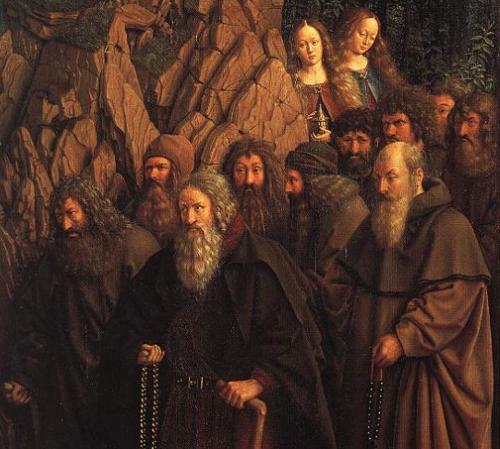
But in the St. Bavo Cathedral — i.e., Ghent — altarpiece, Van Eyck manages to insert a panel of “Holy Hermits.” It is the only place where something of life outside the polite ecclesiastical and wealthy circles of his patrons occurs, if we are not to count the frankness of his naked Eve. By the date of his painting (1430) few hermits would presumably have remained in Europe, let alone taken a prominent place in religious art, but these hermits are, after all, historical hermits, and the implications of eremitism for Van Eyck’s contemporaries would have been well nigh lost to antiquarianism. Like the giant St. Christopher who leads the saints in the adjacent panel, the altarpiece is intended to recall highlights of religious history, not to advocate a new ecclesiastical hierarchy.

The hermits look suitably gruff, now that they are safely extinct. Were it not for their brown robes, they are characteristically and simultaneously pious and menacing, emerging from a forest seclusion and coming around a bend. Behind them two angels oversee the troupe. It is a portrait of eremitism that is classical in every sense. But look carefully into their eyes, the posture of their heads and faces, their reluctant gait. One can imagine a radical simplicity in these holy hermits, especially those at the back of the troupe. They don’t want to be there, playing a role crafted by someone else. They’ve not seen the light of city or sovereign for a long time, and they are almost ready to bolt back into the forest. Or so one might imagine.

Holy Hermits, from the Ghent altarpiece
Holy Hermits, from the Ghent altarpiece, Jan van Eyck, 1430

Gryllos

Michel Foucault notes, in his book Madness and Civilization, that the medieval depiction of the desert hermit of early Christianity was one of being assailed by external demons. The view conformed to the writings about the hermits. These were temptations requiring enormous effort to combat, but external temptations nevertheless.

However, in the late Middle Ages, with the end of leprosy as an underlying social fear and the closing of all leprosaria all over Europe, a transformation took place transferring the external disease to a spiritual and internal state of folly or madness. This is an oversimplification, of course; Foucault is more specific.

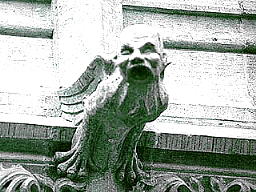
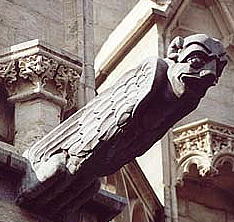
This transformation was applied to depictions of the desert hermits as well. As Foucault states: “In the fifteenth century the gryllos, image of human madness, becomes one of the preferred figures in the countless Temptations.”

gryllos of St. Pierre di Louvain, 15th century
St. Pierre di Louvain
gryllos of St. Michel, Brussels, 15th century
St. Michel cathedral, Brussels


The Temptations are artistic representations of a theme, namely the temptations of the desert hermits. Historically they had depicted (especially in literature) a devil or demon that, however terrifying, was nevertheless a limited if fantastic and separate beast (the customary horns, tail, and smoke). But the gryllos is a hybrid of human and animal, as if the human being was now possessed by a demon solely because of being tempted.

This represented a significant social and psychological change, not to say theological.

What assails the hermit’s tranquility is not objects of desire, but these hermetic, demented forms which have risen from a dream, and remain silent and furtive on the surface of a world. In the Lisbon Temptation, facing Saint Anthony sits one of these figures born of madness, of its solitude, of its penitence, of its privations; a wan smile lights this bodiless face, the pure presence of anxiety in the form of an agile grimace.

The Lisbon Temptation is the famous tryptych “Temptation of St. Anthony” by the Hieronymus Bosch preserved in Lisbon, Portugal (http://www.wga.hu/frames-e.html?/html/b/bosch/90anthon/ and http://www.ibiblio.org/wm/paint/auth/bosch/tempt-ant/). The figure in the central panel of the tryptych is a kneeling St. Anthony.

As Nicholas Pioch (or an editor) of the WebMuseum succinctly puts it:

The central panel of this triptych illustrates the kneeling figure of St Anthony being tormented by devils. These include a man with a thistle for a head, and a fish that is half gondola. Bizarre and singular as such images seem to us, many would have been familiar to Bosch’s contemporaries because they relate to Flemish proverbs and religious terminology. What is so extraordinary is that these imaginary creatures are painted with utter conviction, as though they truly existed. He has invested each bizarre or outlandish creation with the same obvious realism as the naturalistic animal and human elements. His nightmarish images seem to possess an inexplicable surrealistic power.

Foucault continues:

Now it is exactly this nightmare silhouette that is at once the subject and object of the temptation; it is this figure which fascinates the gaze of the ascetic — both are prisoners of a kind of mirror interrogation, which remains unanswered in a silence inhabited only by the monstrous swarm that surrounds them. The gryllos no longer recalls man, by its satiritic form, to his spiritual vocation forgotten in the folly of desire. It is madness become Temptation; all it embodies of the impossible, the fantastic, the inhuman, all that suggests the unnatural, the writhing, of an insane presence on the earth’s surface — all this is precisely what gives the gryollos its strange power. The freedom, however frightening, of his dreams, the hallucinations of his madness, have more power of attraction for fifteenth-century man than the desirable reality of the flesh.

Foucault’s interpretation, like that of the classic Johan Huizinga’s The Waning of the Middle Ages years before, suggests the cause of the end of eremitism as the same as what ended the Middle Ages: the end of a reasonable spirituality. Even while the hermit was an eccentric figure practicing a radical simplicity, he was throughout the Middle Ages an “awesome” religious symbol revered for his spiritual power if not his freedom. But the dissolution of the spiritual is, as Foucault shows, the dissolution of reason (or reasonableness) and the ascent of madness in culture. Even if we do not ascribe to a given spirituality, we will have to account for its social function sooner or later.

The creatures depicted in church art as gryllos (half human, half fantastic animal) and the hybrid monsters of Bosch’s semi-religious paintings are projections of the psychology of a dying culture, a culture riddled with fear and madness.

Fear and madness are the plagues of a culture that cannot tolerate solitude, silence, simplicity, harmony with nature, nor eremitism. For in these depictions of society the times are too far gone, purpose, meaning, and a reasonable norm are lost. The millenarianism of this era presented the coming end of the world not suggested by anything real but by the behavior of the people themselves, conjuring fear, terror, and madness. The end of the world is suggested not by anything real but because the minds and hearts of the people require it.

Keltner on emotions

With a title like Born to be Good one can tell that Dacher Keltner’s book about behavior and neuroscience echoes his Buddhist sympathies, and, indeed, he has attended the neuroscience conferences sponsored by the Dalai Lama, which seek to reconcile science and Buddhist psychology. Hence the subtitle of the book: The Science of a Meaningful Life.

Keltner is a professor at the University of California, Berkeley, and directs the Berkeley Social Interaction Laboratory. Although it has been covered before, the material Keltner presents is in a popularizing and refreshing way. He concentrates on aspects of behavior eliciting the reader’s interest: facial expressions, gestures, touch — and how corresponding parts of the brain register various emotions, culminating in compassion and awe. Keltner uses the Confucian term jen for the optimal sense of behavior and balance, and while the term may be new to some readers and therefore have no other connotation, jen historically refers to the characteristics of a gentleman in the ancient Chinese imperial court, extrapolated to a universal sense of personal ethics. This may not be what Keltner wants, but at least he does not belabor the term.

The book discusses interrelations of nerve function and the brain, with the author’s ongoing mapping of emotional responses to specific areas of the brain. The vagus nerve, for example, Keltner calls the “nerve of compassion” — not because it measures compassion per se but because its primitive function in the “fight or flight” response is capable of reflecting a hierarchy of emotions. The vagus nerve yields measurements from the colon to spleen to heart and lungs, to laryngeal and facial muscles, and does so with the entire gamut of emotion responses. The vagus touches nearly every internal organ, ascending to the medulla ob longita. The fight or flight response in humans basically reflects fear on the one hand and aggression on the other. As techniques come to pacify and control these extremes of response, the vagus nerve will reflect the change in comparison to the conventional measurements of emotions the average person.

Keltner doesn’t elaborate on the “fight or flight” mechanism, but it reminds one of Erich Fromm’s Anatomy of Human Destructiveness, which early established the duality of aggressive response in human behavior. In contrast to instinctivists and behaviorists, Fromm cited the “fight or flight” reaction in human behavior as a vestige of animal defensive response, versus violence and cruelty only characteristic in human beings, not a benign defensive response but a socially and culturally conditioned response, wholly offensive. The capability of human beings to consciously distinguish these two responses enables an observer like Keltner to refine the observations of neurology. Thus the reduction of tension and anxiety in people is measurable in facial muscles, heartbeat, respiratory sinus arrhythmia (RSA), and oxytocin receptors. The vagus nerve is activated with stress and reduced with calmness. The fight or flight reaction itself is reduced in a mammalian counterpart of reptilian immobilization. Of course that’s only how it looks to the panic-stricken and the aggressive.

This information is not new, of course, but Keltner helps popularize what remains tentative and buried away from popular understanding of psychology. But the subjects of his experiments are themselves part of that general public, and certainly influenced by society and culture, but the goal of neuroscience is to find if there are universally applicable results. Keltner thinks so.

The discussion of awe is especially interesting. Awe has historically been reserved for religious emotion, but it was the English thinker Edmund Burke, in his Philosophical Enquiry into the Origin of Our Ideas of the Sublime and Beautiful, who identified a secular counterpart of awe. Burke identified power and obscurity as key elements in our experience of awe with regards to both aesthetics and life experiences. Keltner identifies the social, physical, and cognitive sources of elicitors of awe in this secular sense.

In the social, awe may be elicited in the experience of a powerful and charismatic leader, in the execution or observation of a great skill (for example, a musician or athlete), or in experiencing a great virtue. In the physical world, awe may be elicited from something in nature, or even something human-made (for example, a cathedral). Even cognitive fields can elicit awe, as when reflecting on a complex theory or having an intellectual epiphany.

Awe spans from a sense of vastness in the above examples to a sense of accommodation in the feeling of smallness of self. In either case we intuit — or sense — a unity, a commonality, with everything, leading to a heightened respect as much as a heightened sense of reverence, the latter being a sense of astonishment. In either case, the smallness of self is a prerequisite to a new personal ethic. It serves the group the person may be involved with by reducing the self or ego, but ultimately it serves the person himself or herself in promoting self-esteem in the constructive sense of crafting a meaningful life. Although awe in the secular sense may have questionable objects (physical awe experienced by a dictator’s swaying rhetoric, for example), it is a continuum of emotional responses linked with empathy and compassion that are most conducive to satisfactory brain responses. Keltner is suggesting that we don’t get that far unless we literally experience awe, because that is where the prime receptors operate. By that time, however, if we have developed the sense of empathy and compassion, then awe feeds back to an approximation to jen and a meaningful life.

hus, the hierarchy of receptors runs from sensory pleasure at an “animal” level of anticipation and the registration of rewarding stimuli, through relf-referential behavior such as pride, then compassion, then all the way up to awe and its registration in particular parts of the brain. Here is a brief chart compiled from Keltner’s text:

EMOTION BRAIN LOCATION (& vagus nerve) RESPONSE
sensory pleasure nucleus accombens;
left dorsal lateral prefrontal cortex & hippocampus
release of opioids -> anticipation and registration of rewarding stimuli; memory; reflective thought
pride rostral medial prefronal cortex
(frontal lobes)
self-referential
harm and suffering amygdala fight or flight
compassion (= observation of harm + appreciation of sufferer’s experience) dorsal medial prefrontal cortex
(frontal lobes)
empathy, beginning of perspective
awe left orbitofrontal cortex entire gamut:
anticipation & reward;
fight-or-flight -> adversarial defense
goal-directed action -> approachability;
reflection on internal experience -> perspective

Off the grid

Along with the dream hut (previous entry), the modern solitary dreams of being “off-grid,” at least as a symbol of autonomy and self-sufficiency. After becoming dependent on modern civilization’s provisions for the three essentials — food, energy, and waste management — the notion of addressing these necessities without the grid is inspiring both practically and philosophically, especially for the solitary who already has a disengaged frame of mind when it comes to society’s structures.

But as Dave Black points out in his little book Living Off the Grid, we are never really completely autonomous from it using modern solutions. Food can be grown and bartered almost exclusively by simple, even primitive, means. But energy feeds on itself. To go solar means to go to the grid for the equipment, tools, infrastructure, transportation, and — most importantly — maintenance. Production costs for solar components remain high, and so do end user prices. But most telling is when something goes wrong, breaks, needs maintenance, or additional components. We go to the grid to get them. So we are not entirely “off the grid” regardless of the type of alternative energy.

This is not to say that the effort is not worth it. On the contrary, the degrees of autonomy are important to approaching sustainability. Like solitude, there is no absolute degree, only positive ones.

The same is true for waste management, where virtually every municipality insists on expensive waste disposal for anyone contemplating living on a piece of land, however economically. And it is the grid that requires, verifies, and builds septic systems. The vagabond may make easier provisions, but merely passes on the burden to the grid if they are passing through that system.

We can use the past as a model, necessarily retrograde, unraveling the layers of administration, institutions, customs — and most importantly, the technology. But, again, the technology of the past was based on smaller populations and scientific knowledge-base. It was not free of errors, disasters, or bad effects like pollutants and disease. But the latter are still with us, in different forms. The technology of the grid is a structure, but the real control belongs to those who hold what Foucault calls “power/knowledge.” So we have to get used to the idea that the grid was never “ours” but was part of a material progress lurching back and forth to the unintended but foreseeable goal of expiration.

Black identifies three relationships to the grid — he calls them “subcultures.” They are:

  1. the “welfare subculture,” wherein people driven to marginal socio-economic circumstances depend on public assistance to stay on the grid while unable to move out of this subculture. We will see more and more of these people as the global economy first shrinks, then unravels;
  2. the “vagabond subculture,” wherein people capable of productively settling into a stable relationship to the grid refuse to do so, existing on the fringes, living as cheaply and autonomously as possible while using the grid selectively, and,
  3. the “career subculture,” wherein people work regularly, consume regularly, and have come to depend on the regularity of the grid and the presumed limitless responses the grid uses to provide food, energy, and waste management on its (the majority subculture’s) behalf. Many here, too, will enter the welfare or vagabond subcultures as the economy and the grid downsize indefinitely.

The majority subculture in the developed world — the career subculture — is characterized by an unsustainable level of consumption and equally unquestioning expectation that that consumption level and expectation should continue both as structure and entitlement. The welfare subculture is equally dependent on the grid, if not so optimistically. The vagabond subculture has the attitude of opportunism that distinguishes it from the other two, but may not have the ability to compromise and participate in sustainable alternatives. Of course, those alternatives, such as transition towns, may reproduce if not the economics of the grid, perhaps the social dynamics, with a new class of controlling elites who can produce and a larger dependent subculture of exiles from the grid who accept the authority of the new elites.

Is there a fourth subculture? The disengagement from society characteristic of the hermit has affinities with the vagabond without the element of opportunism. The historical hermit also had rid himself or herself of the acquisitiveness of the rest of society, the adherence to social structures and the desire to fit into them, to conform to its authorities and customs — all characteristic of the “career subculture” and its historical antecedent. At the same time, historical hermits made no demands on the “grid” of their age, preferring to seek their own sustainability in remote areas, or becoming part of the “welfare subculture” by begging or bartering their labor but with no strings attached and no expectations about the future.

At least in mind and heart, the solitary is always “off the grid” of society. Whatever new model may emerge in the future, eremitism will always have a more lasting set of values. The future hermit will be like the old hermit, wondering, as the ancient desert hermit Paul did, “What new cities have arisen? What empire holds sway these days?”

Dream huts

The solitary’s comfort is the niche, the corner, the cell, the room — even when contained in a flat or house. Personal space is configured around the familiar, that which is assigned meaning. What is evoked here? The primordial womb? Or simply a projection of the inner self, the dream-self, the self in which we have necessarily invested so much time and energy, literally a lifetime? A vanity? This self we have nurtured like a small and fragile thing, separated from the world, an endangered species but not an egoism, is just a humble sentience. So should its dwelling be.

Historically, the hermit pursued a physical setting with great deliberation. A cave was just so, likewise the hut or the spot in the forest. The 13th-century Japanese writer Kamo no Chomei identified the ideal hut as a ten-foot square hut (article). And that remains an ideal for most solitaries, even if it is “contained” in a house.

In all possible hermit dwellings, it is simplicity — a creative simplicity actively reducing the conventions of the world to their essential solitude — that reigns in design, style, space, and functionality. The effort at making a dwelling is more conscious and deliberate than that of any commercial and worldly designer or architect motivated by wealth, pretension, security fears, or status. So many sources on small living or simple living nowadays disappoints the solitary because they concretizes — literally — the very soul of the aspirant for solitude, silence, simplicity, and naturalness with their monstrous boxes for a mindless mass intent on living for what is external to themselves. But, fortunately, many other sources today value the appropriateness of simple living and small dwellings.

Here are just a few dream-huts that I have come across to inspire eremitism. They actually exist and are made to order by their designers, usually small entrepreneurs. (BTW, the Jamaica is not from the Caribbean island but from Jamaica, Vermont! And the Better Barns cabin is supposed to be a barn!). There are many other hut designs out there, but these catch one’s attention because they are so deliberate in simplicity of design, and could easily accommodate a modern-day Kamo or hut-dreamer.

Arvesund: Hermits cabin
Arvesund: Hermit's cabin
Jalopy cabin
Jalopy cabin
Jamaica cabin
Jamaica cabin
Ranger cabin
Ranger cabin
Better Barns cabin
Better Barns cabin
Sheldon cabin
Sheldon cabin

Perpetuation

Scientists say that immortality is a projection of the animal instinct for survival. This is a reductionism, inevitably more complex than this bald statement, for it does not account for consciousness and its mental products. A better approach might be that of Krishnamurti, although it, too, is brief and leaves out many things.

J. Krishnamurti argues that our relations with our environment, from early one, form the self. All of this data from environment, society, and culture, constitute the self, down to the symbols and language we use to think and communicate, to the externals of food, clothing, and beliefs. All of this data constitutes our consciousness, and everyone “tries to immortalize the product of environment; that thing which is the result of the environment we try to make eternal.”

This data is not consciousness but our consciousness of a self, an “I.” Krishnamurti elaborates:

You are continually seeking immortality for this “I.” In other words, falsehood tries to become the real, the eternal. When you understand the significance of the environment, there is no reaction and, therefore, no conflict between the reaction, that is, between what we call the “I” and the creator of the reaction, which is the environment. So this seeking for immortality, this craving to be certain, to be lasting, is called the process of evolution, the process of acquiring truth or God or the understanding of life.

Krishnamurti’s premise is that the “I” or self is a collection of impressions and reactions, but that directly examined it has no existence. Or, rather, nothing that we need assume would perpetuate itself. If we assume that this “I” must respond and react and engage its environment, the result is conflict, struggle, and inevitable suffering. On a larger scale, the elusive “I” creates institutions and collective bodies that will function as projections of the self to enshrine the symbols, rituals, and mores deemed necessary to the preservation of the self and its attachments.

Do not think this struggle between the self and the environment, which you call the true struggle, is true. Isn’t there a struggle taking place in each only of you between yourself and your environment, your surroundings, your husband, your wife, your child, your neighbor, your society, your political organizations? Is there not a constant battle going on? You consider that battle necessary in order to help you to realize happiness, truth, immortality, or ecstasy. To put it differently: “What you consider to be the truth is but self-consciousness, the “I,” which is all the time trying to become immortal, and the environment, which I say is the continual movement of the false. This movement of the false becomes your ever-changing environment, which is called progress, evolution.

At this point, Kirshnamurti goes on to discuss the self, but an important point is made here, that immortality is not simply an instinct goine bad but is a reaction to the human struggle with environment, with the alienation or separation that we feel from our environment. That this environment is always changing, always in flux, is absorbed by our consciousness as a condition of self. This flux is manifested in anything dealing with our environment, with others, society, and culture. We are on a carousel of time, as the popular song puts it, but only because we insist on monitoring and being on top of the flux.

So, while human beings elaborate the sense of immortality primarily in religious terms, it is not exclusively so. Everyone, of every shade of belief, elaborates this sense by fight the stream of time and change, by seeking to grasp the environment and controlling it to one’s own profit.

The path suggested by Krishnamurti is a philosophical one, but many who are not philosophical attempt to resolve the dilemma of “I” through creativity. Creativity is at the heart of projection of self. We devise ways of distinguishing what we think is truly creative from the artificial, the synthetic, the contrived. This is the making of values.

Immortality can first be distinguished from survival. We know that we don’t need to be creative in order to survive, or do much more than engage in society’s assigned path for us, whatever that may seem to be. Survival is largely taken care of by society and others. We are inevitably and inextricably tied up with one another, so that we partake of whatever we need for physical survival and elect whatever we think we need for psychological survival. The latter category is when we intersect with the contrived aspects of society, especially entertainment, superfluous consumer desires, use of wealth to pursue success, profit, war.

Yet contrivances do not disturb but build the “I” or ego. Once we have failed to distinguish the contrived from the creative, the false path to immortality is etched upon us, except that the path is a finite and eartly one that merely perpetuates the self and maintains it from reflection.

Creativity must be something extra, therefore, supremely unnecessary to survival or socialization but a resolution, or at least a transcendence, of conflict, something sublime or extrapolated even beyond the guarantees of survival and immortality, certainly beyond the ethos of contrived social entertainments. Even the skeptical scientist pursues creativity.

We can catalog the methods by which human beings extrapolate the survival instinct, but soon see the instinct wane, and other factors of sociability enter and take a larger and more elective role. Ultimately, individuals can submerge themselves in the contrivances of others, in the social relations that even passive observation offers. A routine of labor, housing, eating, socializing, and entertainment is ostensibly the equivalent of animal survival, but it is so heavily dependent on social networks for its character that instinct is transformed into a pleasure principle. At that point, individuality is subsumed into the mass, manipulated by the few holding power or notoriety.

The word “notoriety” originally referred merely to the known, the talked about, but eventually came to have a negative connotation, as in “notorious.” Similarly, “celebrity” originally referred to the status of being known to the many. The transformation of these concepts in modern time points to the expansion of society and the presentation of the powerful and their victims to the public for moral lessons. The contriving of celebrities to be celebrated and the notorious to be execrated is as much a product of how culture empowers itself and perpetuates its power over individuals. What is more of a divergence to the individual than to monitor the doings of packaged issues and concerns that are here today and replaced with a new and equally distracting set tomorrow?

Krishnamurti extends the fabric of social immortality to religion as a social contrivance as much as to modern entertainment with its mind-numbing function of guaranteeing the passing to time without pain or suffering. The search for a savior is the search for a guarantor of immortality, but also the search for one who will celebrate and corroborate the self, the “I” and its contents. It is only a matter of degrees between the mechanisms society creates in order to oth affirm immortality (of a sort) and deny it as sufficient in this lifetime.

The characteristics of celebrity and notoriety are exactly the opposite of the hermit’s. It is not that the hermit lacks creativity. The celebrity and the notorious are not necessarily more creative than anyone else, only that they are made to channel that creativity to the interests of mass society. The truly creative are seldom noticed or outright anonymous, circumscribed by the time, place, and the extension of their egos. The hermit is not projecting himself or herself in order to fulfill an animal instinct. Indeed, the hermit dissipates instinct by reclusing from society and from the “being known in the world.” Regardless of how narrow the world of the hermit, it is, as the Japanese Zen poet put it, “a universe.”

The hermit’s response to the world is not self-denial. Calls to serve humanity or utilize one’s skills or reach one’s potential are siren calls from society to put the individual to work on its behalf. Working for the world is the opposite of creativity. Creativity is the opposite of instinct. Creativity transcends immortality.

The hermit experiences an unconscious recognition that the mind and heart are destined for other than instinct and survival, other than the flattery of self and ego. This otherness means other than the paths of the world, other than the expectations of society. This sublime realization is what comforts the hermit in knowing that the wild chase of humanity for survival, for perpetuation, for the assertion of “values” is vain at every level, doomed to be thwarted by the very products of society and culture.

Nature is the only guide, not society and culture, for even when civilization carries, like a vessel, the creative efforts of sages past, it also carries the malevolent elements of human consciousness made social. The biblical parable of the wheat and tares (weeds), wherein it is impossible to separate the two because removing the weeds will damage the wheat, is certainly the experience of any gardener or farmer who understands natural methods. Yet the parable only makes more obvious the need to begin the process early and methodically, for it is a necessary process to safeguard the fruit of the field, the fruit of the heart and mind. The weeds flourish because they, too, have similar needs as the wheat for nourishment, sun, water, soil. So does everyone. But the great mass of humanity will hoard the nutrients and choke out the good fruit — such is society and the individual who knows the ways of the world and would pursue another way. The mass of people will choke out the intuitive and creativty within them to chase after the world and its profeered immortality, its mechanism of transference with regard to celebrities and the notorious.

The hermit must dissemble to get along in society, but once within his or her cell, room, flat, house — within the privacy of the self not shaped by the world — creativity, conviviality with nature and the universe, the quest for virtual identity with both flux and transcendencecan begin.

The solitary’s way is of humility not hubris, disengagement not contention, self-effacement not celebrity or notoriety. The hermit rushes to nature and the pattern of the universe, not the contrivances of society and culture ready-made to dull the individual, to fill the individual with illusions, to distract self from introspection. Noise, pleasure, false creativity, the desire to perpetuate the debris of environment, as Krishnamurti might call it, have always been shunned by solitaries. The hermit’s way is modest, reclusive, with barely a footprint as to where the hermit has tread.

Happy the man, whose wish and care
A few paternal acres bound,
Content to breathe his native air
In his own ground.

Whose herds with milk, whose fields with bread,
Whose flocks supply him with attire;
Whose trees in summer yield him shade,
In winter fire.

Blest, who can unconcern`dly find
Hours, days, and years, slide soft away
In health of body, peace of mind,
Quiet by day.

Sound sleep by night; study and ease
Together mix`d, sweet recreation,
And innocence, which most does please
With meditation.

Thus let me live, unseen, unknown;
Thus unlamented let me die;
Steal from the world, and not a stone
Tell where I lie.

Solitude, by Alexander Pope

Primitivism

Primitivism is a political and social theory that proposes a human nature and a best-case scenario for social viability. As the name suggests, primitivism advocates a return to what it posits as human society in a primitive setting. This setting is sometimes derived from that of existing indigenous peoples (Latin America, Africa or Pacific Island), but is really to be found only in the past, the pre- and proto-historical past: Neanderthal and Cro-Magnon times, the era of the hunter-gatherer. Even then, of course, it is only a projection, an idealization, without support from any science — which, in turn, primitivism rejects as a product of what it opposes.

The argument of primitivism is that modern civilization, indeed, any civilization, is inimical to the nature of human beings. All institutions and technologies represented by civilization are judged to be oppressive. Since the evolution of civilization is largely the evolution of institutions and technology, the primitivist advocates the setting of the hunter-gatherer to be the ideal, if not best, scenario.

One could dismiss these notions as morally plausible but hopelessly Rousseauean and abstract. Primitivism is sometimes described as a form of anarchism, but because anarchism wants to address a social setting for everybody that is viable here and now, anarchism rejects primitivism as retrograde and utopian. Anarchism is more viable because it begins constructively and without forms or ideals that are historical impossibilities.

Unlike a formal theory of anarchism, which is based on a societal model, primitivism has no interest in mass society, or, more precisely, accepts no accountability for the logic of implementing primitivist ideas on a scale larger than the individual. The result is a vague package of theory and speculation presented as viable — but not viable beyond the individual, and it is questionable for the individual as well. The scenario of hunter-gatherer holds more misleading premises and conclusions that are as inimical to others as they are potentially to the line of logic of its advocates.

The first dubious argument is that the hunter-gatherer was morally superior to a person in civilization. While the latter would be largely the product of socialization and hold values second-hand, the hunter-gather derived values (presumably) only from life experience, which would have been, as Hobbes put it (in a different context), “nasty, brutish, and short.” Violence and aggression were more fundamental to early human beings than the primitivist is willing to admit, holding instead to the image of an idealized post-simian society of leisure and plenty. But an individual could not easily survive alone in pre-historic times, and society itself developed from individual cooperation, from individuals working on behalf of the tribe in collective enterprises, not merely individuals on the hunt dragging back prey to be divided up in egalitarian fashion to each according to his need.

Hunting and fishing are intrinsically violent actions. They differ from the violence in food habits of carnivores (simians are not carnivores), which lack an equivalent of the human level of self-consciousness. Animals follow instincts and capacities, and their food-procurement methods are direct and necessary. However, once human beings evolved consciousness, acts of violence such as hunting became an exacerbation of the primordial remnants of the animal brain as much as imitations of animal necessity.

The psychological and social cycle of violence was experienced by humans at a deeper level of consciousness than that of an animal. The experience would have plunged into the psyche and manifested itself in other social ways. Hence, the latent potential for violence and aggression in every human being today is only barely contained, through displacement and ritual, by complex society, by “civilization.” Was violence as containable in hunter-gatherer society lacking institutions, symbols, and rituals — until these, too, evolved?

Of course, civilization reserves for itself forms of aggression and violence not unique to itself but having its origins in human nature, which include human experience in the primitive era. Civilization regularly calls upon these baser instincts. We have only to look around us to see these sublimated but real channels for aggression artfully — but sometimes not so deceptively — played out.

Furthermore, aggression and violence would extend from survival instinct to include not only food but reproduction, territoriality, and physical comfort. Here is the core of human troubles, already established long before the ills of civilization.

This point leads directly to the second dubious premise of primitivism concerning the origins of civilization. In order to explain the shift from the idealized hunter-gatherer setting to corrupting civilization, a leap of faith in an Eden-like fall is necessary. Somewhere, somehow — goes the explanation — strong individuals cowed weaker ones into obedience, and set themselves up as leaders, authorities, and alphas. Such runs the primitivist explanation.

This explanation is derived by analogy to simian behavior, except, again, no mechanism explains the transition from simian domination behavior to primitive human ideal and its corruption to the equivalent of simian domination. This transition, as with Darwinian evolution, has a missing link, except that with evolution environmental pressures can account for disruptions to the group, while primitivism has no independent factors to present other than a corruption of human nature itself. Hence the analogy to origin and fall mythologies.

The solution is ironic because it argues that human nature is not purely benign as the original Rouseauean premise argued. Instead, suddenly, human nature turns against itself to create civilization, which primitivism posits as the moral and psychological opposite of the hunter-gather state. As with biblical Eden, we have no clue as to how the devil got into the garden if he wasn’t suppose to exist at all.

It may be speculated, in turn, that primitivism excoriates civilization in a fundamental revolt against authority — hence, the generic label of anarchism, which has, by the way, been applied to most hermits in history. But existential and psychological theories, too, offer a serious critique of civilization in moral terms without a primitivist solution. Granted, the primitivist critique is often useful, but imitative and with nowhere to turn for explanation or solace. Ultimately, the argument for a hunter-gather model must needs be both a psychological and an ethical one, but cannot be an anthropological or scientific one.

Primitivism cannot escape the necessity of presenting a body of ethics. To do so from a prehistoric stage, however, is going to be deliberate evasion. Who knows so much about that stage, that consciousness? The posited primitive scenario may have no ethics, or an ethic of license, or an ethic of power, or an ethic of altruism — it all depends on what particular behavior is taken to be representative of human nature. But all evidence points to a continuity of human nature from then to today.

Eliminating civilization, too, avoids the ethical issue of means. Today, climate change, peak energy, and the devolution of globalization strongly suggest a collapse scenario in the near future (decades, not centuries). The state of post-collapse humanity is an unknown. But Nietzsche, writing in the late 19th century, had already given the Western world two centuries of viability — and one has already passed. Many persuasive voices from philosophical to literary, not to mention scientists from around the world, have already pronounced on the same schedule, but in their own styles, never triumphalist, always conscious of the underlying mechanisms in the human heart.

Is primitivism not conscious of its implied nihilism in cheering on the collapse of civilization because of institutionalized violence? If the death of God was received by Dostoyevsky with lament not for religion but for human behavior, then cheering on the death of civilization is nearly the same end. In Freudian terms, some can cheer on the death of the Father (Thanatos) but must own the impossibility of taking the father’s place. Who has faith that human consciousness can transcend these deaths?

Civilization is not the sum of its parts. Civilization is the vehicle, not the content. Civilization is the vessel of centuries of thought, wisdom, and creativity — as much as the carrier of stillborn demons. The demons are stirring in the womb, and the death of Gaia (to use scientist James Lovelock’s imagery) will kill both the demons and the womb.

But this, too, was foreseen by the philosophers as a situation of modernity. The death impulse can be traced all the way back — not to the origins of civilization as the work of Cain but to the moment of consciousness when a human being lifted a tool, killed an animal, and (unlike other animals), remembered how compelling was the experience.

Theory of progress

A theory of linear succession or progress has been the premise of Western philosophy of history from the beginning of the Christian era and on through today. In the earlier form, taken from biblical sources, the line went from creation to fall to redemption to apocalypse: a straight-forward line exemplified by Augustine’s City of God but nascent in all the thinking of the era.

With the Renaissance and Enlightenment, the same point of view is merely secularized, and progress is recast as the evolving of reason, knowledge, discovery, and technological advancement. In the 19th century, Hegel established the framework for a philosophy of progress, and Darwin’s theory of evolution provided a scientific confirmation, especially for the nascent sociology of the time.

But one of the representative writings on the subject, The Idea of Progress by the British historian J. B. Bury, argues that the theory of progress was not possible until the 17th century — not in antiquity, the Middle Ages, nor even in the Renaissance, for three reasons: 1) the view that Greece and Rome had attained the apex of civilization, 2) a lack of acknowledgment of the value of mundane life and its contribution to society, and 3) the lack of a separation between science and philosophy which would free science for its revolutionary breakthroughs.

Hence, Bury would not link the Christian view to a formal theory of progress, nor to Hegel, probably, but to concrete material conditions resulting from the application of post-17th century thought. However, when this theory of progress is contrasted with an alternative such as the Eastern cyclical view or Nietzschean recurrence does it become clear that the theory of progress is distinctly Western, nor merely Christian, scientific, or modern.

The optimism of the West in the continued evolution of society on principles of social and technological progress is basic to Western thought, a faith in rational principles leading to universal improvements, to a best of possible worlds. But the pragmatic theory of progress is functionally contrived by those few who would benefit from the extension of the instruments and institutional structures of progress (economic, financial, political, military, educational, etc.). The average person is expected to accept the notion that society can undergo constant evolution and progress so long as that innate force within history (Spirit, Reason, Science, the “market”) is allowed to be interpreted by the authorities, much like the ancient Roman augurs.

Every once in a while, this acceptance is gainsaid in a particular part of the world, but like a natural seismic eruption or the cycle of tidal ebb and flow, conditions return to where they were, only with new faces replacing the old ones.

Only with the 20th century has faith in the theory of progress been shattered in the minds of many intellectuals, though the majority of the people stubbornly adhere to the augurs of progress. World War I had an enormous impact on a generation of writers, artists, and thinkers, but their work has been viewed by critics (under the rubric of “the academy”) as a subjective expression of mere stress, angst, and the hothouse behavior that results when a person is placed under unnerving conditions.

A theory of progress, decorum, and complementarianism (the view that creative efforts should be expressions of the social-political paradigm, what in the Soviet Union was called social realism) persists in media and popular expression. The coverage selected and the criticism applied has the function of keeping within bounds what the masses consume, what they must consume in order to maintain allegiance to the present paradigm of institutions and beliefs. Underlying these beliefs must be a theory of progress, implicit in the notion that security, order, and well-being are granted by power from above and not sought for or achieved by independent individual effort.

Progress can only be a product of individual consciousness defining health and well-being. No sage has ever advocated consulting the institutions of his age for wisdom but recommended plumbing the mind or heart within to derive direction. Only after the death of sages is the message seized by others for their aggrandizement, made to be a theory of power and domination, and set forth to undermine the spirit of the orginal sage, which always preferred individual effort and a philosophy of solitude and benevolence.

Solitude is inimical to power, shuns power, seeks its own progress. A progress that is an illusion, enhancing the few and fooling the masses, is for the solitary the opposite of progress, for it does not consult nature or quiet the mind in order to begin reconsturcting the self. But the theory of progress is an old device masking power, and concealing what the 20th century creative souls — and those brave 19th century figures like Kierkegaard and Nietzsche — unmasked as lies about human nature.

What is the alternative to progress for the grand institutions of today? It is a devolution to simplicity, to individuals and small social units, to natural industry and exchange, to a relationship to nature based on value and not exploitation or power. The alternative to progress is a devolution of artificial wealth, privilege, and legitimacy.

The “decline of the West” (to cite Spengler’s title) means not only the decline of the theory of progress but the decline of the artificial social and economic conditions that have propped up institutions and circles of wealth and power based on belief in that theory. Here is a beginning point for anyone who has not connected the experience of the 20th century “Age of Anxiety” with the present devolution of global systems of power. Here is the beginning point for a philosophy of solitude based on a realization that progress is a chimera, a fog that suppresses mind, spirit, and body.

Tao te ching 8

Chapter 8 of the Lao-tzu Tao te ching presents water as that from which virtues can be derived by imitation of its characteristics. Water is an example of how nature (or an object of nature) teaches or presents models for human behavior that allow the individual to identify what is fruitful and harmonious for the self. While one may argue that other models of nature exist (“nature red in tooth and claw,” for example), they are out of context with the totality and often a priori. Taoism presents water as a universal object, at all times and in all contexts. The characteristics of water underlie the potentialities and actions of the myriad creatures, among them human beings.

(Here again we’ll use the D. C. Lau translation for its clarity and scholarship.)

Highest good is like water.
Because water excels in benefiting the myriad creatures
without contending with them
and settles where none would like to be,
water comes close to the Tao.

The opening paragraph describes water as not contending or striving with anyone or anything. This characteristic of water is a benefit to all. Water yields when confrontation looms, goes forward when opportunity is available, pulls back and waits patiently when obstacles arise. And water always seeks out the lowest place, that place where there will be no contention because nothing else wants to be so lowly.

Humility is a recurrent theme in the Tao te ching, but one does not necessarily associate water with humility. The characteristic is contextual: a booming ocean wave contrasted to a country ditch or a latrine. But it is water all the same.

The virtues of water are the virtues of sages and hermits. Obscurity is not literal. Water does not hide, flee, or disappear, but it is often hard to find and when found is hard to identify in its origin. So the sage is standing before us, or is one we never see or realize has wisdom. The hermit, too, is walking amongst us, in the city, the town, the countryside — not necessarily hidden away in a monastery or cave or distant hut.

But might as well be, for the hermit is a solitary in mind, heart, and spirit, and naturally seeks out the places where no one goes, indirectly benefiting everyone by lack of contention — by lifting up a heart full of nature and joy, but not as the world celebrates it. The hermit is flexible and a lifting of heart is contextual, as is a quiet or sad heart – booming wave or quiet trickle. The sage and hermit are flexible and easily live in simple or harsh conditions, demanding little, observant of the cycles of nature as they will benefit him or her, just as the sage and hermit will benefit nature and its creatures by not harming, abusing, or exploiting them.

The cycle of seasons instructs the sage and hermit, and water is an integral aspect of each. Not that the hermit is obliged to live in any given place. The taiga of Russia or the deserts of the Middle East were mono-seasonal, though they had subtle changes of season to which the hermit was attentive. Every change of season, even changes in cold or hot places, are brought about by water.

There are modern writers who say that water cures nearly all diseases, based on the premise that blood and tissue and electrical impulses are all based on uses of water and its elements in the body and in the atmosphere. The purity and simplicity of water is a metaphor for health and well-being.

Tao te ching 8 applies the notion of deriving virtues from nature to specific virtues that, like water, benefit all yet retain simplicity and obscurity in their non-contention. Following D. C. Lau, these are two sets of threes, skipping the interpolation of a reference to house-siting, which suggests a later feng-shui interest not appropriate to Lao-tzu:

In quality of mind it is depth that matters
In friendship it is benevolence
In speech it is good faith
In government it is order
In affairs it is ability
In action it is timeliness.

Alternatively, here is Red Pine’s more literal version:

thinking with depth
helping with kindness
speaking with truth
governing with peace
working with skill
moving with time

The first set of three applies to the individual: self, other, others; the second set applies to social interactions: government, business, world. The refrain (in Lau) about what matters in each case establishes, first, the reality confronted by the individual, and then the virtue that should be pursued in order to make the reality non-contentious.

Thus the quality of mind is best when deep, as in meditation, where idle thoughts and images not only do not disturb mind but further do not contribute to depth. The quality of friendship consists in the kindness or mutuality that is shared in non-contention, in the relationship of courtesy and openness that friends share. Communication beyond that is best characterized by “good faith,” or honesty, constructiveness, “truth” in Red Pine’s version — in words that are few but meaningful.

On the social level, government is best when its function is to maintain order. Order means peace internally and externally. Benevolence must first come from individuals in this scheme — if this prerequisite does not exist, government will be incapable of order. Likewise, business (“affairs” or “work”) must be characterized by mutual exchange of abilities, skills, and products of quality, functionality, and endurance. Without this virtue to business transactions, fraud and corruption result. But this fraud will have been the product of previous lack of virtue in this hierarchy from self, friends, society, and “government” or ordered interactions.

Thus, by “government” Lao-tzu refers to the convention of the emperor, but reduces it to order, ultimately a product of individuals. By “affairs” Lao-tzu refers to the convention of business, reducing it to exchanges of productivity and skill, as when a farmer sells his produce or a craftsman makes a tool. Reducing virtues to fundamentals brings us closer to visualizing the simplicity of personal relations, and brings us closer to the context of ancient China when the Tao te ching was composed.

Finally, the reference to action (or “moving”) means that only with these many preconditions does the virtuous person safely “act” or participate. At that point, the acting is to embrace a beneficent situation. The timing of action must be right because beneficence does not always manifest itself in all these factors from mind to friendships to business. If no one in the world is virtuous, the hermit will not act. Thus we extrapolate the Confucian advice to “recluse when the emperor is evil” and we anticipate Chuang-tzu’s philosophy of “non-action” in evil times.

The last sentence in this chapter probably belongs at the end of the paragraph on water:

It is because it does not contend that it is never at fault.

The sage or hermit of today can apply the virtues of water to life itself. These virtues are not mere metaphors or abstractions. The virtues show us how to find in non-contention a source of happiness and well-being.