Thought-worms

Popular psychologist Oliver Sacks did not coin the phrase “earworm” — the snippets of popular music that repeat themselves over and over in one’s mind — but his book Musicophilia offers a fascinating look at the relationship between the environment of sound and the mind. Awareness of “earworms” is now familiar but the discussion is not original. Advice on getting rid of earworms ranges from simply replacing the earworm with a new snippet, or ignoring them, but the logical question is why they occur in the first place.

Most of the discussion concentrates on sound and its reception in the brain. But a larger analogy is more instructive. Earworms occur in the same manner as thoughts.

Thoughts can embed themselves in the mind as obnoxious little refrains, but have the ability to spawn off more thoughts, producing a mesh of mental entanglements. Most people do not notice “thought-worms” because they fill their time with busy work, conversation, self-commentary, and noise. Silence brings them to consciousness. Meditation instantly reveals the presence of thought-worms, like an unerring diagnostic. But there is no easy treatment for thought-worms other than meditative practice applied consistently.

As with obnoxious sound, advice for breaking the clutches of thoughts ranges from replacing annoying thoughts with benign “thoughts” such as numbers or words. Meditation advisers suggest “in breath-out breath” or “one-two,” etc., or other mantras and prayer formula. These methods are the equivalent of replacing earworms with new snippets of music, different earworms, more innocuous ones re content, helpful at first but inadequate in the long run.

Another method of getting rid of thoughts during meditation is allowing thoughts to dissipate, like floaters before one’s eyes, or looking at something fixedly, either in the mind’s eye or physically before us, such as a statue or the floor or a point in space, or looking at nothing at all, with eyes closed or nearly so.

Perhaps the optimum meditative state, regardless of method — and the simplest, emptiest method seems best — is achieving a sleep-like consciousness or awareness wherein the body becomes rested and autonomic by design, a state wherein the meditator watches the body as from afar — but not too closely or the “spell” is broken and the meditator “awakens,” if ever so delicately.

This is not self-hypnosis, for consciousness remains clear, available, independent, and autonomous.

The dream states of sleep are forms of rest wherein the conscious part of the mind, the part which guides our conscious actions throughout the waking day, is unraveled and helpless in its needed state of non-intervention. This state parallels the calm emptiness and attentive silence of meditation, except that at this point the phenomena of dreaming begins.

Dreaming repairs the damage of thoughts and articulations of emotions (fear, anger, love) transmuted into suppressed feelings during waking states. We may well have acted on our feelings during our conscious state, but the bulk of feelings lies deep within our mind and remains unseen by the conscious state. Deep sleep allows these feelings to express themselves, to unravel and dissipate themselves if our mind is in a healthy state, or to intensify and spread if our minds are not healthy. We awaken refreshed, resolved, and capable — or we awaken uneasy, fearful, and uncertain. It is not the uncertainty of philosophy but rather the animal instinct of fear and uncertainty of one’s plight and situation. Like an animal without its habitat, we instinctively waste the function of sleep when we enter it with thoughts afire. Thus are thoughts called “poison” in the Buddhist tradition, for any thought is a concession of sorts.

Sages and saints have often been described pursuing austerities such as little sleep. Such a practice is not to be pursued by the average, or even advanced, person, for the function of sleep is biological, intrinsic to health and well-being. What is the advantage of sleep deprivation among the saints and sages? We must speculate that at their point of mental control, their short sleep is not deprivation after all. For if sleep repairs the damage of conscious thoughts, of thought-worms, then an advanced meditator has achieved significant control of the mind, has a mind already at subconscious rest, so that the detoxifying function of sleep is not needed, and only the physiological function of physical health is required.

Meditation mimics the positive function of sleep by allowing the mind to achieve a respite from thoughts, a respite that can form a practiced understanding of balance and health. Sleep then is freed to complete its function of scavenging for bad effects in the mind. Dreaming becomes creative and playful rather than instrumental and function. In the latter state, the subconscious mind needs to work with projections and symbols of repressed fears and anxieties. Constructive dreaming demonstrates the potential of all of us to create, to maintain a convivial relationship to our environment, to our world, and to the natural world especially.

The whole of dream interpretation remains too embedded in Freudian typology, which reduces dream content to representations of specific objects and meanings. While we cannot take Freud’s symbolism literally, the notion that certain objects represent certain emotions is now taken for granted, especially after Jung. Situational presentation of the symbols is what counts, however. A bear in a dream, for example, may represent a menace or may represent innocence, clumsiness, or naivete. Though books offer dream interpretation as how-to manuals, most of what we dream and what the objects represent have to do entirely with our own situations.

Art and creativity is lucid dreaming. They express what is within through a channel of emptiness within the mind, like an aperture in our otherwise conscious and tight mind, like sunlight behind the mask or masks we may be carrying. The artist is someone who has discovered the aperture from which creativity can bypass the masks. The aperture widens as the masks shrink. Art is so often pursued in privacy and solitude because the creation of art is an intensely subjective activity, intensely personal, like a dream not to be interrupted, like meditation not to be interrupted.

Yet this creativity, the potential to express the deepest feelings and perceptions, exists in every person. This creativity is not expressed by every person not because of shame or guilt over its content or a sense of humility in relation to other. In part, the skills and aptitude will never be discovered because most people take socialization as a terminus to creativity, a vast conforming to and pursuit of what society and culture demands, a constant chase after its design and presentation of reality. The suppression of self and potential becomes a necessity not so much for social function but for civil order and cultural conformity and control. The waste of creativity is the extinction of individual potential, regardless of whether potentially expressed as art or other self-expression. Few people ij life even perform the work that they like, let alone express creativity of any sort.

To rediscover creativity in the self is to discover potential. To express that which will develop potential in the self requires first access to the tools of the mind, combined with the tools of the environment. To begin this process one cannot assume the gift of the artist, which is the gift of accessing the aperture in the subconscious mind. To begin this process requires the detoxifying of the mind’s accretions derived from society, culture, and the baggage of self. At the heart of this process cannot be mere belief or hope or desire but simply practice, meditative practice, in whatever form the individual discovers it to be most efficacious.

Even if our potential seems to dissipate in the passage of time and responsibilities, the moments of contentment that result from meditative practice will filter the mind, the emotions, the instincts. Practice brings the respite of solitude and silence that permits moments of insight and contentment.

Gongora’s “Solitudes”

Luis de Gongora (1561-1627) published Solitudes or Soledades in 1612, representative of the era of Spanish Golden Age poetry. But these Solitudes have little to do with solitude. The poems are set in isolated physical locales and reflective of solitary landscapes. But the lengthy poems are of little interest to solitaries, barely meriting an article or extended essay. As their modern translator Edward Meryon Wilson notes in his 1965 preface to the poems:

The story of The Solitudes is not important in itself and has little narrative interest. It is merely a convenient peg on which Gongora could hang his superb descriptions, elaborated by all the arts of metaphor and hyperbole, and interspersed with beautiful lyrics. The action takes place in a world that is curiously artificial and rich. …

Thus, the first Solitude (there are only two anyway, the planned additional two never having been composed) begins with a shipwrecked youth who explores the shore and discovers a shepherd’s hut. Gongora describes the hut as a hermitage, a “well-found” hermitage, further rhapsodizing about it as “Temple of Palas,” as “Flora’s granary,” as “Edifice sublime,” as a place where there is no pride, flattery, envy, ambitious care, favor, false security.

After these paeans of praise, the poem quickly moves on to even more artificial sentiments.

Gongora’s artificiality is in part a device of his era, and in part an ignorance of his supposed subject. The poet had little interest in solitude. He was of a comfortable family, and became a church deacon, ordained a priest late in life, often reprimanded for his habits, including gambling and bullfights. Accused by the local bishop of not attending church services, Gongora responded that he attended whenever his superiors did. Gongora was fond of wealth, talkative, argumentative, and slothful. His feud with rival poet Francisco de Quevedo was played out in derisive poems that only lowered Gongora’s reputation. Ultimately his penchant for card-playing left him impoverished in old age. Too late to make the acquaintance of solitude and hermitages.

Buddh Gaia

Late Irish thinker John Moriarty once told an interviewer that he had been writing the same book all his life. Thus, among those books best singled out is Night Journey to Buddh Gaia as representative of Moriarty’s theme: the “twelve woes” of cultural unconscious, simmering below the surface of Western thought and action. He itemizes them as representative myth or history:

the pre-cosmic Abyss
the Cedar Forest
the sandbank of Apophus
the pit in Lascaux
Pasiphae’s calving ground
the Theatre of Dionysius in Athens
the Colosseum in Rome
the Green Chapel
the cemetery in Elsinore
the deck of the Pequod
Dover Beach
Auschwitz

Note how as time passes, myth becomes more and more history, until time and psyche converge.

Each “woe” is not merely an act of cultural violence but a reverberation of the haunting instinct of aggression within the human psyche made large into the cultural psyche or unconscious, spilling out over time to belie any sense of moral or epistemological progress in the West. Moriarty cites Nietzsche’s comment that in his time has been discovered that the Jurassic will have its say in us. From Mesopotamia to Egypt to Judea to Greece to Rome and on into the modern era, the West has always been intent on slaying dragons, on vanquishing enemies, on applying a “final solution.” And thus, in short, the West has “failed.”

Moriarty is a grand storyteller, and his recreation of the myths, weaving back and forth to illustrate their import with philosophy and literary analysis, creates a intriguing canvas of high points of insight. For example, the felling of the first tree in the Cedar Forest — Gilgamesh’s quest to slay the beast and forest-guardian Huwara — reverberates down the centuries as the first ecocide. Though that is not the term Moriarty uses.

Of Job and Macbeth, Moriarty writes:

There are such nights. There is suffering. Therefore there is not nihil, the nihil that would make possible the consolation that is the gift of nihilism. Is this Hell? Not yet, because at this early hour of the night there is still the buoyancy of desperation. And giving cruelty a medium in which to be cruel to the very end, there is the buoyancy of hope still glowing in its own ashes.

Hope for what? For transcendence? The history of the West belies it. Hamlet is caught between the ontological and the anthropological, between the noble and reasonable against the nihilistic. And

Down the road from the cemetery of Elsinore — nihilistically and dualistically down the road from it — is Auschwitz. And there he [Hamlet] is now, ascending past three castle windows, the corpse of Ophelia or it is Polonius pulling him down. It is the awful deadweight of our recent history, including Verdun and Auschwitz, that pulls us down.

And yet we knew it was coming, Nietzsche knew it, saying:

I have discovered for myself that the old human and animal life, indeed the entire prehistory and past of all sentient being, works on, loves on, hates on, thinks on, in me. … I suddenly woke up in the midst of this dream, but only to the consciousness that I am dreaming and that I must go on dreaming lest I perish — as a somnambulist must go on dreaming lest he fall.

So the West goes on dreaming, unconsciously reproducing the horrors of the past on into the present, and justifying it each time, all over again. Thus Auschwitz updates the Western psyche, it becomes what Moriarty calls “a new anthropological category .. [a] phylogenetic recrudescence, … all that is instinctively and rationally tauric in us.”

Is there no way out of the labyrinth? For Moriarty, the solution is a cosmic Christology, a reconceptualizing of Jesus as historical but also cosmic. Where Buddha died in his bed (not Moriarty’s phrase but his import), Jesus goes one step further. Jesus enters suffering with an existential choice: he neither fights (recreating the animal psyche) nor flees (a like recreation) but enters directly into the karmic and transcendent by taking the cup, the “Karmic Cup,” and showing culture and individuals what is the only way out.

Jesus is religiously validated not by

conformity to Old Testament prevision of Him but by what He so originally and so isolatedly underwent. … In doing and undergoing, Jesus is so new that in His presence the New Testament catches sight of little else but it own preconceptions. … [He] is a Neotype in whose presence all archetypes undergo redemptive reconfiguration. … Instead of doing the lazy thing, instead of assimilating Jesus to an available and convenient archetype, what a better apocalypse it would be were we to endure the full shock of Him as neotype. In Him, after so many invalidating false-starts, we have found evolutionary legitimacy.

Not that Moriarty is presenting an institutional figure, a figure crowned with dogma and definition, but a bold new myth that feeds from the East’s methodologies (especially Hindu and Buddhist) to find how the West must do it. He does not mention “fight or flight.” He does not say the Buddha died in his bed. He does not dwell much on Eastern thought at all. But one can pull out the useful threads, extrapolate them, safeguard them from unhelpful criticism, and see where they take us. Moriarty says that the Western mystics (like Eckhart, Suso, Julian of Norwich, Teresa of Avila, John of the Cross) will have the right ontology, the mature anthropology or psychology, the right sense of transcending without offending, the right interface with Eastern thought.

Nor is there mention of new theology or Teilhard de Chardin (unless it is somewhere in the 600-plus pages, which are without index). Gawain and Kurtz (of Conrad’s Heart of Darkness) are to Moriarty as important to the equation as any philosophical treatise. But all depends on a new model, he argues, a new neotype for modernity.

What Jesus achieved is beyond reckoning by myth and mahavakya, by upanishad and sutra, by the Bible, by the Critique of Pure Reason, by The Origin of Species. … In Jesus in Gethsemane all the Earth’s ages are psychologically synchronous.

Moriarty’s dream of restoring Christianity seems like Catholic nostalgia of the post-World War II sort in, say, Christopher Dawson or Jacques Maritain. He even presents 5 points for the refounding of Europe — spiritual principles, ecumenical principles, but not likely to go further than the hermit’s cell, the poet’s table, or the quiet conversation of like minds, sufficiently updated and post-modern. Buddh Gaia is that new city on earth, that new earth, reconciling spirit and aspiration in the new and refashioned model of Jesus. The night journey is history’s journey, humanity’s journey, the Westerner’s tortured journey through the psyche and how to get ready for the dawn — at least in one’s self, if not in Western culture at large. (One may say confidently that it is too late for the latter.) But Moriarty’s sparks of insight brighten that long night’s journey.

Lost key

The late Irish thinker John Moriarty tells a Sufi story, often called a Nasrudin story for the main character. It runs something like this, or you can listen to it with Moriarty’s narration.

A man is walking home at night. As he nears his house he reaches for the key in his pocket and cannot find it there. He checks other pockets and the house key is not in any pocket. He happens to come near a streetlamp, which is shining its light in a little circle around the post. Here the man starts walking around in the light, looking for the key, then he gets on all fours looking for the key within the circle of light. A constable approaches and asks what he is doing. The man explains that he has lost his key. The constable says, “I’ll help you,” and both are on hands and knees in the small circle of light looking for the key. “It’s definitely not here,” says the constable getting to his feet. “Are you sure you lost it here?” The man gets up. “On, no,” he says, pointing off to the dark. “I lost it over there.” “Then why are you looking over here?” the constable says in exasperation. “Because it’s too dark to look for it over there,” answers the man.

And that, says Moriarty, is what we have been doing for centuries — looking for answers, looking for the key to the mystery, looking to philosophical and spiritual resolutions, within the small circle of light that we happen to have already, from reason and plain sensory experience. But it is the same light over the centuries, and the lamp will not show more light but the same concentric little circle evermore.

What we must do is realize that the darkness is not foreign or hostile or impenetrable. And that is where the key lies. The darkness is part of the light and of the universe and of ourselves. Only we must enter darkness in a different way, leaving behind our sensory-intellectual tools, entering the darkness like the mystics, like Teresa of Avila or John of the Cross, the latter who sang “O night, more lovely than the dawn.” Moriarty says that this is the limitation of traditional Christianity (and essentially of the entire West).

The thrust of Moriarty’s thinking, culminating in his book Night Journey to Buddh Gaia, presents a grand exploration into the search for the key, looking to the dark spots of mythology, psychology, religion, poetry, and philosophy.

More on this in the next entry.

Dog, spider, mask

A Husky-Shepherd mix dog regularly frequents the neighborhood. He has a collar, but at the appointed hour he is roaming in Husky style, visiting dogs fenced or otherwise unable to go far. He knows where there are oppressed and friendless dogs, and visits them. He knows where there are cats, bears, rabbits, mean dogs, mean people, dangerous vehicles. He is Han-shan, the hermit dog, roaming the woods, trotting on roads, meticulously avoiding people by leaving the road when they approach. He is never hostile. The time of morning anticipates his movements. Wait for him at a certain hour and he is usually passing by. If you greet him he will not look up. If you move toward him, he will pass on more briskly. Do not impede his way, for though he seems to move about without purpose, he recognizes every boundary line, ditch, rock, and entry. He is Han-shan, the hermit dog.

***

A green spider created a magnificent web under the eaves of the window. The spider was not one of the little random spiders that cannot or does not know how to weave, only producing a set of random threads. This spider was the classic artist of a magnificent symmetrical web that was topped by a better every night, until the web hung from the top of the eave to the bottom of the window, the spider growing large and sitting triumphantly at one end in the center of its ball of silk. The old web decals on the window, for years warding off torpid birds from flying into the glass pane, were pale versions of this web, insufficient imitations. To watch the spider at work, to rise and see the dewdrops on this work of art, was to inspire a faith in nature and beauty.

Then one morning, pulling back the curtain, there was a void — several random threads dangling ominously. There was no spider. She had not worked overnight. Her time had not come for her egg sac, had it, though she had grown large? On the ground beneath the window lay the spider, already shriveling, her magnificent legs pulled back, ants hovering. She was quite dead. Had she managed a secret egg sac after all, or been attacked by a wolf spider, or the chemicals of a mosquito-spraying airplane the previous night (yes, they are odious and ineffective, except at killing everything but mosquitoes — butterflies, moths, dragonflies, perhaps spiders)? The spider’s death was a blow to art, nature, and beauty. The Buddha was right: life is nothing but suffering, not even redeemed at such moments by the memory of beauty and love of nature. Lifting it while still lain out on a stone, the spider was buried quietly in a corner of a garden bed, where, perhaps, she will spin a different manifestation of nature and beauty in a flower.

***

Disappearances are disconcerting because they are often unexpected and startling. Just when familiarity has lulled one into comfort and routine, that which gave comfort, which represented routine, is gone. Not so much the larger things for which one can prepare psychologically, but the little things. Leave a vulnerable child alone too long and it wonders whether her parents will ever come back. Stand on a corner in a strange neighborhood too long and wonder if the bus will ever show up. Work in the same place and wonder if you will survive without the same dull and necessary routine.

Where have the raccoons gone, no longer raiding the compost pile for scraps not buried well? Where did the neighbors chickens go after watching them grow from wee chicks to waddling adults scattered about the neighbors’ lawn roaming innocently? Where do the bears go when there is not enough food or water and the heat far more intense than their heavy fur could anticipate? Where did the bird that sang so magnificently from the oak tree fly? The sly cartoon of the mayfly reading its fortune comes to mind: “Today is the last day of the rest of your life” (echoing the pop formula of decades ago).

The lesson of impermanence is not a lesson but a reprimand, not an insight but a blow. We excrete a shell of armor, like an oyster, expecting a pearl from our resulting invulnerability, but instead it is a mask that we do not know how to wear effectively in moments of passing. How many masks must we wear through before our arms tire of holding them up, our faces grow lined by trying to peer through its eye-holes and seeing only a shadow of what we hoped to see? Where, indeed, do the real things go, the real things as opposed to the impermanent ones that drift back and forth in front of our masks? Must we, as Pema Chodron’s book title suggests, grow comfortable with insecurity, meaning, one supposes, grow comfortable with discomfort, grow secure with our masks of nonchalance, get used to being drained of life and feeling if we don’t want to suffer?

There’s a black cat caught in a high tree top.
There’s a flag-pole rag and the wind won’t stop.
There’s a fossil that’s trapped in a high cliff wall.
There’s a dead salmon frozen in a waterfall.
There’s a blue whale beached by a spring tide’s ebb.
There’s a butterfly trapped in a spider’s web.
There’s a king on a throne with his eyes torn out.
There’s a blind man looking for a shadow of doubt.
There’s a rich man sleeping on a golden bed.
There’s a skeleton choking on a crust of bread.
There’s a red fox torn by a huntsman’s pack.
There’s a black-winged gull with a broken back.
There’s a little black spot on the sun today.
It’s the same old thing as yesterday …

Energy

Modern physics maintains that matter is energy, always pulsating, moving, restless. But what is energy? We cannot but use analogies that contrast matter as solid, stable, and unmoving. Even our notions of moving and unmoving are inadequate because nothing remains unmoved if we look at everything as energy.

The traditional yin-yang symbol of Taoism offers a representation of perpetual movement, but this perpetualness or indefiniteness of movement, is presented as patterned and symmetrical, whereas our experience of the universe is that eents occur assymetically. At least that is our perception, and we call it serendipitous, or the result of building pressures or conditions. Ultimately, our definitions of events must remain open and causes, meanings, and effects undefinable. This gap dogs both science and imagination.
Also representative of “perpetualness” are the enormous cycles of Buddhist kalpas wherein time and beings inexorably move, however slowly to our consciousness, however “assymetically” to our limited consciousness, a grand movement from one state or bundle of identifiableness to one less definable, to another that becomes definable, and so forth. In this vaguely “scientific” expression, the kalpas perhaps allow Westerners to accept and demythologize reincarnation to the point of tolerance, even prescience, if not literalness. But the disturbing lack of finality implied by energy, even slowed but never resolved, is foreign to conventional thought, especially Western thought.

In contrast to Eastern tradition, Western thought is bound up with the linear and with progress, lines and spirals in a great chain of being. Here the expressions of the past (theses) transmute into new uptakes (antitheses) and work themselves into new expressions (syntheses).

With Enlightenment thought, progress became material, social, and cultural. Hegel made his idealism — wherein the real is rational, necessary, inevitable, right, and the rational is real — manifest itself in history as necessity. Marx inverted the same dialectics by recognizing that the real is rational only insofar as the material conditions sustain it, but that the real is neither right nor necessary, and can change or be changed. In contrast to the aberrations of authoritarian and totalitarian regimes in the 20th century and beyond, not, in fact, strictly Western, Marxist dialectics do describe Western structures, but only because they assume the given Western thesis of progress and linear transformation built into the structures, built into the entire mentality of Western thought. The dialectics work best applied only to the West, in fact, and only falling short of accounting for a Western version of change and materialism that outstrips the historical conditions that could not foreseen in the 19th century, except, perhaps, by the very proponents of an unbridled material progress that had no social component.

Why has Eastern tradition refused change and progress? — referring to a now nearly moribund tradition, however. Spengler called this disinterest in change the “changlelessness of non-history.” He speculated that the excitement in the West, for example, over the steam engine in the 19th century, was experienced by China — in the Bronze Age, around 4000 BCE! An often cited example contrasting East and West is China’s use of gunpowder for fireworks contrasting vividly with Alfred Nobel’s dynamite soon weaponized for warfare (against his civil engineering interest) and Albert Einstein’s atomic research turned into bombs. Both men regretted the change, the development, the progress applied to their creativity. Nobel went so far as to consult with pacifists throughout Europe, eventually creating a peace prize which itself has become distorted and weaponized.

Did the attitude of “changelessness” arise consciously from a rejection of history, a rejection of time and place, of geographical or cultural factors? Perhaps the mountain landscapes of ancient China or the primordial forests and seas of ancient Japan suggest a philosophy of nature that spiritualizes beings, makes of beings a holiness, so that they are representations of the eternal even as they chart their lifespans? Lifespan is the yin-yang cycle, but on a larger scale; it transpires as a foreground, wherein the backdrop is the living silence and solitude of mountains, rivers, forests, sky that appears unchanging and eternal. To ancient Chinese, mining mountains, damming rivers, felling trees, were all arrogant and evil acts. The least intervention with nature was considered the wisest course. Nature extended not only to the beings of our environment but to the actions of individuals.

Contrarily, in the West, from the beginning, the coveting the gold in mountains, draining swamps and channeling rivers for commerce, felling trees for limitless fuel, poisoning the land of enemies by sowing salt (or depleted uranium), and building towers and missiles to scratch and scrape the skies above are signs of progress, not hubris. The West has closed the openness of eons, charted and graphed the universe between Big Bang and Entropy, scoured the heavens with SETI readings, but fails to understand its own motives, its own self-destruction and its willful destruction of other peoples and of nature. The linear depiction of time and history in Western thought transcends religion, for both scripture and science maintain the same cosmology.

But what underlies all that is living? At a minimum, it is the sensitive wave that science calls energy, that neither recedes nor goes forward without returning. Ancient and Eastern peoples treasured the root, the source, the origins, but Western civilization dispenses with the lessons of the past, even the recent lessons, on an inexorable and mad propulsion into the future. Dropping the inheritance of the past, ditching behind it the too slow nature and the too sluggish time, the West leads the world into a darkness.

The ancient philosopher Chao Chih-Chien noted that

Those who cultivate the Tao ignore the twigs and seek the root. This is the movement of the Tao — to return to where the mind is still and empty and actions soft and week. The Tao, however, does not actually come or go. It never leaves, hence it cannot return. Only what has form returns.

That primordial energy, that source of Something and Nothing, as Lao-tzu says in chapter 40 of the Tao te ching, underlines everything:

The Tao moves the other way
the Tao works through weakness
the tings of this world come from something
something comes from nothing

Mountain, without & within

The physical fields of great austerities have been the desert and the mountains. Both physical contexts remove society and the ego but in different ways, through different metaphors, so to speak. The desert as physical emptiness, associated with dryness, heat, thirst, overbearing brightness, horizonalism, sparsity of living beings. Mountains connote coldness, snow, water, darkness, verticality, a profusion of living beings on the scale of ascent. Neither setting is habitable to the average person. Both represent metaphors of emptiness, forms of transcendence. Both settings have presented their near-inhabitants with religious and spiritual settings for austerities.

Shugendo is the Japanese asceticism of mountains, derived in part from Shinto’s assignment of sacred places in nature, with the mountain as dwelling of spiritual beings, plus the image of transcendence. Shugenda evolved from a mingling of Shinto and esoteric Buddhism, plus a degree of philosophical Taoism. As with Tibetan Buddhism, mountain life conjures a special relationship to natural objects and spirits, as if the heights and the separation from the valleys and flat lands below automatically elevates the person to a new level of spiritual aspiration.

Because of the physical austerities of mountain life, and the disciplinary practices equated to martial training, those who sought out its rigors in Japan were attracted to the warrior life: yamabushi and samuri. While desert hermits have used the vocabulary of combat against demons, their discipline is largely a mental exercise that then overcomes physical pain or discomfort.

In contrast, mountain asceticism in Japan extended to a whole class of male adventurers, soldiers, penitents, and strength-builders not necessarily imbued by religion — or, rather, carving out a martial religiosity akin to eternal combat against a panoply of gods and demons. Such is the evolution of many natural disciplines in East Asia.

The physical austerities may have come first, evolving into sedentary mental exercises later. For example, hatha yoga, the discipline of India’s Brahmins, the religious elite of Hinduism, may have preceded mental and philosophical training paralleling, supplementing, or even coming later. Until this evolution, ritual and mythology would substitute for philosophy and spirituality.

Another example is the evolution of Qigong into Tai chi chuan and on into advanced martial arts specialties. (There is no equivalent in the West. The Greek Olympics did not engender the later schools of philosophy.) An evolved Shintoism redirected martial impulses to a contemplation of nature: trees, rivers, mountains. An evolved Buddhism (Tendai, Shingon) redirected these impulses to discipline, transcendence, a denial of ego. The resulting Shugendo has remained the preserve of male asceticism, with a great deal of ritualism and a minimal emphasis on intellectualism.

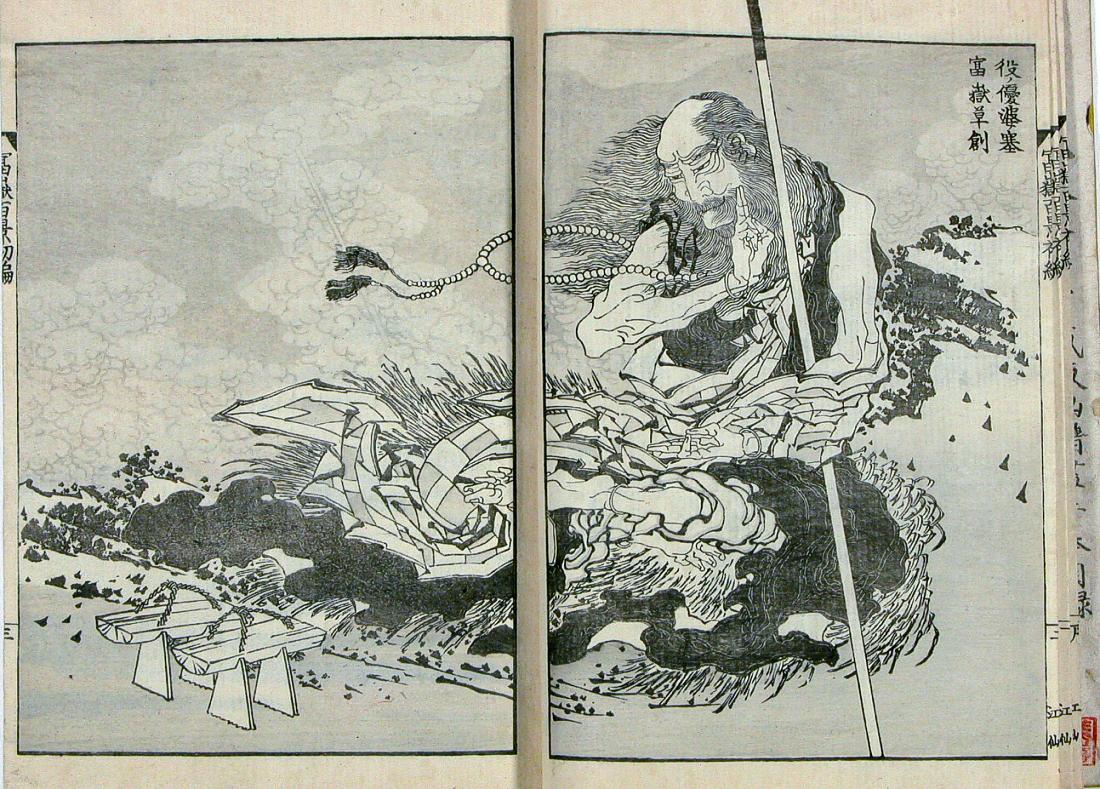
Shugendo is dominated by the image of Enno Gyoja, a 7th century historical figure whom legend transformed into a “founder.” The very name means “En the ascetic.” According to legend, Enno was exiled for trespassing on a mountain in order to pursue religious practice, but every night he flew to the favored mountain, defying his exile. Enno is closely associated, at least by the 19th century artist Hokusai, with the sacred Mount Fuji, appearing as its patron in the artist’s renowned “One Hundred Views of Mt. Fuji.

Enno Gyoja Opens Mt. Fuji
"Enno Gyoja Opens Mt. Fuji"

In Hokusai’s modern but spiritualized portrait, Enno Gyoja is depicted as a powerful and self-disciplined man, a capable ascetic, neither god nor warrior, a hermit or holy man renouncing the world and probably any pretensions to supernatural powers. Without the legendary material surrounding the Shugendo founder, however, perhaps the mountains would not have attracted what the scholar Paul Swanson has enumerated as “ascetics, including unofficial monks, peripatetic holy men (hijiri), pilgrimage guides, blink musicians, exorcists, hermits, diviners, and wandering holy men.”

Desert, without & within

The early Christian desert hermits said very little about the desert as geography or physical locale. The physical context of solitude and a sense of the absolute described briefly by writer Paul Bowles (previous entry) is the setting, but the setting is seldom discussed or described by them. Rather, the desert setting establishes the maximum psychological parameters of the human mind and soul, beyond which there is no further going, an infinite presentation into which all finds its place but which restlessly continues onward and inward. Thus the hermit Macarius, called the Great, one day tells his brothers to flee. “Where could we flee beyond this desert?” they ask. “Macarius put his fingers to his lips and said, ‘Flee that,’ and he went into his cell, shut the door and sat down.” For the vast infinitude of the desert is but a microcosm of the hermit’s cell.

Desert spirituality is well explained by Belden Lane in his book, The Solace of Fierce Landscapes, reviewed here. As he puts it:

Why do people choose to live in such a landscape, poised, as it is, on the edge of nothingness? “Something about the desert inclines all living things to harshness and acerbity,” says Ed Abbey. It touches our extremities. The desert fathers and mothers chose their barren locale because its values matched their own. They, too, opted to thrive on the boundary where life and death meet, living as simply as possible, with as few words as necessary, separated from the fragile anxieties of the world they had left behind.

Thus the true hermit understands that the emptying of self must resemble the earth’s emptying of itself. The choices of desert and mountain examined by Lane differ both in quality and style. Historically, mountains have represented the dwelling-places of gods and enlightened beings, while deserts have been depicted as the dwelling places of demons and malevolent spirits. Perhaps they represent the psychology of Frost’s famous little poem:

Some say the world will end in fire;
Some say in ice.
From what I’ve tasted of desire
I hold with those who favor fire.
But if it had to perish twice,
I think I know enough of hate
To say that for destruction ice
Is also great
And would suffice.

Here the fire and ice are within, just as the desert and mountain must be. But Frost sees both as inevitable extremes in human beings, with ice as coldness and hatred, with fire as war and destruction. These emotional opposites at play within the human mind are both destructive. Yet at the same time, they destroy one another if the mind simply watches, allows them to pass, to disintegrate for lack of an anchoring place. The mind must let go of desires, emotions, entanglements. This will happen when we “perish twice,” when we end both and come into being with a receptive and solitary heart. It is then that the desert and mountain compliment our inner being. Until then, both places seem forbidding, and indeed are destructive and intolerant of human life.

If the desert is the test of physical and psychological tenacity, then old age and death test psychological and spiritual tenacity. Old age and infirmity haunts everyone, including the hermit. Old age is not merely the transition to death but the end of autonomy. Physical and spiritual liberty is found in the desert, the silence and solitude of desert life, the life one carries about within oneself every moment. Desert life (the inner desert) envelopes and nurtures the mind and heart. Everything else is the world. Can we carry our desert into that final house of physical dependency and personal loss?

In the case of the ancient desert hermit, who was to pass his last days with monks, he grieved nevertheless for the lost days of inner life dissipated by even the presence of others. How much more so the modern hermit can expect the faceless treatment of bureaucracy and of the well-intentioned — or the less so. The infinity of the desert carried within the self is, like the natural desert, a fragile environment honed over much time.

When a certain elder had to leave the desert for the city because of his infirmity and age, a visitor saw him and asked why he grieved. “What would you do in the desert, now that you are so old?” The old man looked at him and pondered sorrowfully. “Was not the mere liberty of my soul enough for me in the desert?”

The Vitam Patrum records another passage about the physical desert. This passage, like the anecdotes above, quickly translate the physical desert into the state of solitude and equanimity constantly nurtured in the self. And it accepts the challenge of death.

There is another place in the inner desert …. To this spot those who have had their first initiation and who desire to live a remoter life, stripped of all its trappings, withdraw themselves: for the desert is vast, and the cells are sundered from one another by so wide a space that none is in sight of his neighbour, nor can any voice be heard. One by one they abide in their cells, a mighty silence and a great quiet among them. Only on the Saturday and on the Sunday do they come together to church, and there they see each other face to face as folk restored in heaven. If by chance any one is missing in that gathering, straightway they understand he has been detained by some unevenness of his body, and they all go to visit him, not indeed all of them together but at different times and each carrying with him whatever he may have by him at home that might seem grateful to the sick. But for no other use dare any disturb the silence of his neighbor …

So the cell modeled the desert for not only the hermit in his tiny dwelling, but later for the monks who sought in vain to adequately reproduce this desert in a communitarian setting. The lifeline of community in the like-minded hermits was undoubtedly precious to each of them, though we have stories of hermits dying alone. So the hermits developed a kind and circumscribed routine of taking care of one another, of setting a day when each would appear not for social conviviality but for the higher liturgy that merely served as a social device for confirming one another’s physical needs. This model was reproduced among the Carthusians, and every order calling itself a hermit order in the West. In the east, the hermit would more likely disappear into forest or mountain (as prescribed in Hindu asrama, for example), there to be delivered to whatever fate was wisest. But the East Asian examples in the Japanese Buddhist hijiri and wanderers requires an essay of its own.

So the Christian desert hermits developed a silent and tacit system of checking upon one another. But even then, it was met with a mix of relief andreluctance. This was the constant psychological dilemma of, for example, the French hermit Charles de Foucauld, revolving around the extreme desire of solitude.

In some ways, the issue of solitude versus helo will resonate with hermits of any age or state of health. Even when put in spiritual terms, though, the psychological simmers somewhere below, in the subconscious. When the abbot Marcus visited Arsenius, Arsensius was not pleased. Marcus said to Arsenius: “Why do you flee from us?” The old man replied: “God knows I love you, but I cannot be with both God and men.”

Baptism of solitude

American expatriate writer and composer Paul Bowles (1910-1999) once wrote a little travel essay titled “Baptism of Solitude.” The essay describes what he tells us the French call le bapteme de la solitude, referring to the unique sensation of encountering the desert, specifically the Sahara Desert, whether for the “first or the tenth time.” The essay opens:

Immediately when you arrive in the Sahara, for the first or the tenth time, you notice the stillness. An incredible, absolute silence prevails outside the towns, and within, even in busy places like the markets, there is a hushed quality in the air, as if the quiet were a conscious force which, resembling the intrusion of sound, minimizes and disperses sound straightaway.

The absence of sound, which is silence, is only part of a natural component of solitude.

Then there is the sky, compared to which all other skies seem faint-hearted efforts. Solid and luminous, it is always the focal point of the landscape.

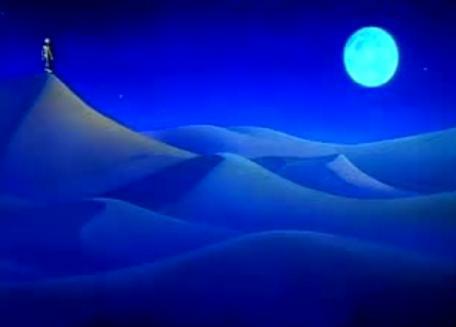
Bowles describes the sky at night, which though filled with stars is never quite dark but “an intense and burning blue.” And there is nothing else, especially leaving the town, the camels, and going up into the dunes, or out on a stone ledge, leaving everything behind. The peculiar sensation — if the viewer does not rush back inside — is a desire to linger, to stay.

It is a unique sensation, and it has nothing to do with loneliness, for loneliness presupposes memory. Here, in this wholly mineral landscape lighted by stars like flares, even memory disappears; nothing is left but your own breathing and the sound of your heart beating. A strange, and by no means pleasant, process of reintegration begins inside you, and you have the choice of fighting against it, and insisting on remaining the person you have always been, or letting it take its course. For no one who has stayed in the Sahara for a while is quite the same as when he came.

The rest of the essay goes on to describe the social life of Arabs, Touaregs, Sudanese and Mauritanian blacks, and the French in the Sahara before Algeria independence. Bowles describes the wonderful oases and their verdant orchards and grainfields, the extremes of day and night temperatures, the rare but turbulent rainfalls, the effect of the desert on the White Fathers — the religious order of missionaries who ended up acquiring “a certain healthy and unorthodox fatalism.” The essay is a consummate piece of travel literature.

“Baptism of Solitude” does not pursue the historical meaning of the desert. It is an introduction for moderns and Westerners, but anyone acquainted with the early Christian desert hermits will fill in the psychological side that Bowles’ descriptive and suggestive essay begins to describe. He comes to the edge of this vast topic of desert solitude, of the absoluteness it represents, aware that his reader can only come so far with him. So Bowles concludes about what going to the desert ought to suggest to a modern-minded person.

Perhaps the logical question to ask at this point is: Why go? The answer is that when a man has been there and undergone the baptism of solitude he can’t help himself. Once he has been under the spell of the vast, luminous, silent country, no other place is quite strong enough for him, no other surroundings can provide the supremely satisfying sensation of existing in the midst of something that is absolute. He will go back, whatever the cost in comfort and money, for the absolute has no price.

Bowles recorded a reading of this essay in 1994 at his home in Tangiers. The sense of Bowles’ essay and spoken words are imaginatively captured by a 2000 short graphic film “Baptism Of Solitude: A Tribute To Paul Bowles” by Tonya Hurley, available on YouTube.

from Baptism of Solitude: A Tribute to Paul Bowles
from "Baptism of Solitude: A Tribute to Paul Bowles"

Planting fields, eating rice

A famous koan of The Book of Serenity titled “Dizang Planting the Fields” is prefaced by this setting: the 9th century Chan master Guichen, called “Dizang” because he resided at the Dizang temple once for a little while, is visited by Xiushan, Fayan, and others, who are traveling from the south but whose journey is interrupted by rain, snow, and overflowing streams. They stop at Dizang’s temple. They sit about the brazier, ignoring master Dizang.

Dizang draws closer and says quietly: “May I ask something?” Xiushan looks up and says yes. Dizang asks, “Are the mountains, rivers, and earth identical or separate from your elders?”

Xiushan replies to Dizang, with a tentative voice or perhaps a self-assured one: “Separate.” Dizang holds up two fingers. “Identical! Identical!” Xiushan blurts out. Dizang holds up two fingers again. Then he gets up and leaves.

Once out of earshot, Fayan asks Xiushan what is the meaning of the two fingers. Xiushan replies cooly that Dizang did it artibrarily. It has no meaning. “Don’t insult him,” says Fayan. “Bah,” says Xiushan, “are there elephant’s tusks in a rat’s mouth?”

The next day, the visitors leave, but Fayan tells Xiushan that he is going to stay, that he will catch up with the others if he decides otherwise. But Fayan stays a long time.

This is only the preface to the story, but the personalities are already clearly delineated for what follows. Fayan studied with Dizang a long time. It happened that Xiushan and the others came to Dizang’s temple again. We can imagine the same setting, sitting around the brazier. Dizang speaks first, again.

“You are from the South?” “Yes.” “How is Buddhism in the South these days?” Xiushan replies “There’s a lot of discussion going on.” Dizang asks, “How can that compare to me here planting the fields and eating rice?”

What Dizang intends by the question about Buddhism in the south is to confirm that Xiushan now understood what he did not before, that now he could speak for himself. But instead Xiushan boasted of the busy debate and scholarship going on there, presumably including himself as part of it.

Next Dizang wanted to reveal the nature of all this vain discussion in the south, to at least hear a defense of it, and so refers to his own meagre efforts, his diurnal planting of the fields, which is both figurative and literal. It is to him the essence of practice, in contrast to discussion.

But Xiushan does not accept what Dizang does, and replies, “How about the world?” In other words, Xiushan dismisses Dizang’s activity as the heart of Buddhism and practice. He scorns it as something primitive in contrast to the discussion going on in the south, and by extension in the civilized world. Is this what you are doing while the world does important things? Xiushan suggests.

Dizang responds, “What do you call the world?” How does Xiushan define the “world”? Is it larger, better, deeper, than simply planting the fields and eating its yield? Dizang might have given up on Xiushan’s badgering train of talk and simply said something to the effect that, well, that’s what I do here; it doesn’t matter. Xiushan would not catch on either way.

Most commentary on this story concentrates on the distinction between discussion (communion of speech) and practice (communion with the source). From there the various stages of enlightenment in the Chan/Zen tradition may be discussed, or the use of scriptures and sutras versus meditation. But all this, too, would consist of discussion. The very institution of temples and monasteries, as in the West, eventually led to the creation of a class of meditators and a class of workers, with the latter indoors and performing minimal labor, a severe dichotomy.

But the story of Dizang points directly to the essence of practice as found in the hermits of antiquity. The Commentary in The Book of Serenity:

Even though planting the fields and making rice is ordinary, unless you investigate to the full you don’t know their import. The ancients would reap and boil chestnuts and rice at the edge of a hoe, in a broken-legged pot, deep in the mountains — their fortune was no more than contentment; all their lives they never sought from anyone. Their nobility was no more than purity and serenity — what need for bushels of emblems? … It’s not necessary to open a hall and expound the teachings as in the South. Leave the clamor …