Eight worldly conditions

In the Arugattara Nikaya, an early Pali text, the Buddha comments on the eight vicissitudes of life, the eight worldly conditions that afflict the average person. They are:

  • gain & loss;
  • fame & disrepute;
  • praise & blame;
  • pleasure & pain.

These conditions are opposites or reverses, the other side of one another, existing as poles or extremes on a spectrum, extremes on a pendulum of feelings. They cannot be extracted from one another without the inevitable presence of the other to point back to the character of the original or counterpart. The individual flees one and fights for the other, round and round indefinitely.

Nor are these eight (or four) conditions only experienced by the worldly. These conditions are human conditions of mind and body, core conditions which require a thorough mindfulness on the part of the self.

The argument to the arhat in this little tract is that these worldly conditions are impermanent, such that no credence or assent of mind should be given to them. This is a primitive treatment of a complex psychological topic. While seasoned arhats might be dismissive, the fundamental place of these conditions in the mind and heart require more elaboration.

For when we gain by property, possessions, friendships, achievements at work or social circle or business and professional life, we immediately experience — after the flush of elation — the fear of loss, the tentative nature of gain. The only gain is a like-mindedness to our social efforts, the creation of a viable community, what Buddhism originally meant by sangha — and what the historical Jesus would have meant by community, the Taoist by the “village.” But for the average person, always within is the nagging possibility that even these can be undone, taken away. That does not gainsay the attempt to understand others. It only affirms that the understanding must be ours, independent of the status of the world and other people. And even then, life may take turns that will make our understanding seem hollow and emptied out by sorrow, reversal of fortune, collapse of friendship — in short, loss.

Gain and loss are intimately associated with pleasure and pain. The latter conditions are not merely epicurean or sensual in nature. But they are particularly oriented to the vulnerabilities of the body and the emotions. The gain and loss can be health or sickness, joy or sorrow. Our primordial instinct for survival seeks to protect ourselves from the extreme of pain and loss not with the extreme of gain and pleasure but with the stasis of balance and moderation. Yet moderation, too, may leave us in a vulnerable weakness of will, a lethargy akin to depression. The stasis must be of strength and forbearance, not mere avoidance of extremes. Too many fear stasis means numbness and death. The solitary is usually misinterpreted as fearful of hurt. To become cold-hearted is not the goal of solitude. The goal of solitude is both repair and construction, of self-awareness and understanding. Ultimately, to transcend the impermanence — or the emotional instinct of fear –an identification with larger cycles of reality must follow.

Fame and disrepute seem far from the solitary. That chase of the tail is worse than mere gain and loss, than mere provocations of pleasure and fear. Fame thrusts the self before a world that measures the person not even in terms of the physical (gain and loss) or the sensual (pleasure and pain) but in terms of emotion, feeling, psychological dependence on the external. Praise and blame accompany fame and disrepute. They are the sufferings of one already jostling within the world, already doomed to fail in negotiating with the world. Unwittingly or instinctively, or by vagaries of personality, solitaries have less acquaintance with fame or praise, to their benefits. These conditions level the ambitious quickly and humiliatingly. The chief mistake of the average person is to persist in recovering fame after dispute, praise after blame. The heart of the world is deep within these conditions, deep within the whole cycle of these conditions. There can be no “victory” over these conditions, for they overcome both the mind and heart as soon as engagement begins. Thus, these conditions have been of particular focus in traditions of solitude, where the twin extremes are rejected thoroughly for humility and self-effacement.

The little Pali essay does not present specifics. It presents the Buddha’s admonition to arhats to avoid these worldly conditions because they are impermanent. And while that is true, it is also true that these worldly conditions entwine people to a greater degree than they did 2,000+ years ago. Philosophies of individualism, the material conditions of profit and alienation, the power of institutions, and the technology of both self-containment and socially-networked narcissism are at historical peaks. The worldly conditions outlined by the Buddha are now larger than the impermanence of the individual. Yet these conditions remain at the core of the human psyche, and the resources for addressing them are more scarce than in the historical past.

Mind-body dichotomy

The body-mind or body-soul dichotomy is universal in religious experience because the perception of such a dichotomy is at the core of our human experience, regardless of belief or opinion.

Unlike animal consciousness (or what we think it is) human consciousness disrupts a posited seamless awareness for a persistent reflectiveness. This reflectiveness enables learning and action but also separates us definitively from everything in our environment and, ultimately, from our very selves as a whole entity, not a dichotomy.

This separate consciousness, rootless and without further control, is both the source of creativity and of alienation. It is the source of the immersed feeling when totally enraptured, but also our acute sense of difference from anything “other” when the least bit of non-rapture — which is to say daily existence — intrudes.

One has only to attempt a few minutes of untrained contemplation or meditation to conjure the dichotomy. The mind races away with thoughts, plans, memories, agendas, feelings, speculations — a non-stop litany of words bubbling up from what one would think is a pent-up, suppressed wellspring ready to burst into and completely disrupt the least moment of the mind’s quiet.

The words that fly through our minds depend upon acculturation — in a specific language, in a specific culture, community, socialization. Even the thoughts that arise from our resting mind are dependent upon concrete circumstances. Why do those and not others arise? The thoughts are like dreams, arising from the unconscious, with no mechanism on our part to control them, only to try to understand and interpret them after the fact. So, too, the words that float by in moments of calm — while we want to dismiss them, they are nevertheless revealing a great deal about us.

The ideal of a dreamless sleep is touted as indicating that we are at peace, at rest. But this is not so. We simply fail to remember our dreams and conclude that we have none. Likewise, we are bidden by most meditation guides to ignore our thoughts, to let them float away without attention. But they occur regardless, and have a specific content. If we examine this content we discover our priorities, our hopes, our agendas, our fears, our obsessions, our habits, etc. These thoughts (and sounds) tell us about our conscious life, just as dreams do, but more directly, more literally. They tell us that we are too much in the world, too much a construct of the world, and not of nature, which is empty, without thought, without agendas.

Western culture especially is dominated by the logos, by the word and the supremacy of words as articulations of meaning. What thoughts do infants have prior to language? Do infants not retain the ability to bridge the dichotomy by the absence of words, perhaps even of images, ultimately, of thoughts? Is the identification of body and mind dependent on an evolutionary moment merging with the self, making a single whole of all experience, physical and psychological?

Is every human quest for resolution of the dichotomy simply a search for the “oceanic” feeling, which we mock in self-assured rationalism but which is what animals proximate in living fully (if inevitably) in the moment? But the “oceanic” feeling is not a stupor or a mystical irrationality or a collapse of psychological realism. It is virtually an archetype without symbol or image.

Does the “oceanic” feeling arise as Thanatos, the death wish? The possibility can only be expressed as a kind of myth. The infant’s “soul” does not want the body to be born, does not want to be thrown into existence, not, at any rate, into an existence that will entail suffering and death. So the “soul” identifies with the “oceanic” feeling and wants to cling to this experience, which anticipates and wards off the dichotomy, the dichotomy being life as a human being. And we, in our diurnal existence, not remembering that pre-born feeling, unconsciously long for it as the resolution of the dichotomy.

If no “soul” or mind is attributable to the infant in the womb, only a sensitivity of organs for hearing or touch, etc., then we must gainsay the effect of sounds, for example, that later in life correspond to specific feelings. The ebb and flow of ocean waves are found comforting and peaceful because they are reminiscent of the heartbeat and blood movement heard in the womb, for example. Such an avenue of investigation is speculative and not likely of interest to hard science. The content of unconscious triggers such as sounds and their effects are left to poets, artists, and anyone interested in the psyche.

The most sensitive religious and spiritual traditions are conscious of the more subtle aspects of human relations with our environment, while the grosser historical religions entwined in social and political affairs (the world) miss these subtleties of mind and body. They make a rigid dichotomy between mind and body, then hastily resolve the dichotomy by going outside of the two to posit a solution that obliterates both, and does no reasonable justice to the issue.

The mind is certainly part of the body, just as it is in animals. Where else is it? The dichotomy of mind and body is not in the a posteriori insertion of consciousness into our evolved or created being, but in the tragic sense of the mind’s uniqueness and need for nurture and development if anything is to be made of our lives.

The mind depends on the body for its health and well-being. How we use the body is how we use the mind. Yet the mind is made distinct in us by the potential of awareness and consciousness. How unwise to neglect the welfare of the body, for it reflects at once a lackadaisical or a hostile attitude towards the mind and spirit, a resentment of consciousness. Ultimately, the mind and body work together not merely in daily habits but in supporting the mind’s capability to understand and control itself — just as the self-regulating functions of the body take care of the organs, and work optimally when we become aware of their needs and foster them.

The body-mind dichotomy is itself a part of nature, neither blessing nor curse. Why it exists does not matter, for we cannot assign to this mystery any meaning. But the fact of its existence compels us to awareness. Its reality must be grasped, and from it lessons derived. And its “givenness” is like the “givenness” of everything else in the universe.

Look at the body as body;
Look at the family as family;
Look at the village as village;
Look at the community as community;
Look at the universe as universe.
How are you to know that the universe is like this?
Look!

— Lao-tzu: Tao te ching, 54

Music & evocation

Music is the art of collecting narrative sounds to achieve a desired sensibility. Music has a primordial function because sound precedes other human senses. We are blind before birth and require adjustment of sight even in the hours and days after birth. We cannot comprehend what we touch if our eyes are closed but merely guess at texture. Smell is significantly reduced in human beings compared to most animals. But sound, even when not revealing its source, seems to persuade attention, so that even in the womb, sound has an effect on human development.

Identifying why certain sounds are soothing or relaxing plunges us into an anthropology. For example, waves on a beach may echo the regularity of a mother’s heartbeat in the womb and the regularity of swishing fluids in that primordial chamber of safety. The sound of birdsong signals the absence of predators, and , therefore, sources of stress. We are startled by sudden loud sounds like thunder, gunshot, explosions: these are echoes of predators in the underbrush or unsafe perches in branches or rocks.

Music has attempted to create atmospheres of serenity but the imitation of nature is always short of the real thing. The urgency to relieve stress is itself a revelation of the psychological unsustainability of crowded places. The sound of vehicles and rush of noises disturbs our primordial ability to find a refuge of naturalness. The ultimate failure of music to achieve this alternative vision led John Cage to embrace the noise as itself modern music — an unsatisfactory intellectualization. New Age music comes close to consciously trying to reproduce a human project of serenity. To be creative, however, music must embrace as well a philosophical point of view that is compatible with our deepest sensibilities.

The real challenge is to create music (or sound) that, as Schopenhauer would put it, can exist even if there were no world, no one listening to it. That is, if no one heard it, could it still be an echo of reality? This question initially suggests Cage’s direction for a solution but goes beyond, positing a universe without human intervention and taking the sounds of the universe as music. Recordings of radio waves from the stars are usually rather dull listening, but that is because the sounds have no will, no intentionality. What the artist does is find a way of adding intentionality, or rather, ambiance, that will make the music resonate with a human sensibility.

Ambient and space music would approximate this method, except that the sensible component is usually interpreted and rectifies the course of bare sounds. Dark sounds conjure fear; cloud sounds suggest optimism. The composer is still manipulating the listener, or seeking out those who agree.

Music-making cannot be disengaged from human will, but can be used to present philosophies of life projecting from the emotions stirred by music. The idea would be not to try to baldly reproduce nature sounds but to stimulate emotions which in turn would give the listener a non-intellectualized basis for a philosophy of life. Successful music (in the ear of the beholder) would be that music that best satisfies the given philosophy of life.

A good example, perhaps, might be music that evokes sadness, grief, or melancholy. Five classical pieces come to mind:

  • Albinioni: Adagio
  • Tchaikovsky: Symphony No. 6, 4th movement
  • Mahler: Symphony No. 5, 4th movement
  • Barber: Adagio for Strings
  • Khachaturian: Gayne Ballet Suite, no. 4

Bach showed early in the history of classical music that a work’s foundation in certain mathematical patterns could evoke particular emotions. While the above classical works are famous for evoking certain emotions, the subtleties of works such as Bach’s “Art of Fugue” show that an awareness of complexities can draw out a more sustainable work of art. The five pieces above are usually isolated from the composer’s whole work in order to deliberately provoke rather than provide — provoke a linear emotion rather than provide a context for reflection on life. But that is not the fault of the composers, only of modern audiences too busy to hear out the entire works.

The most representative shakuhachi music of Japan is truly philosophical music in that it assembles sounds to evoke nature and to express a philosophical mood without targeting a linear or single emotion. The mathematical line is as simple as Bach, but its philosophical rooting in Zen clears away extraneous cultural and musical accretions. At the same time, a deepening experience of the music — as with meditation practice — deepens the philosophical suggestibility of the music. This does not mean that the listener must be a philosopher. Successful music will allow the emotional ambiance to percolate through the mind that is already disposed to constructing a philosophy, or at least intuiting one.

Thus, as a counterpart to the Western works that evoke sadness, grief, or melancholy may be placed the famous “Kyorei” (“Empty Bell”). Casual listeners will identify it with melancholy. But this famous work does not so much evoke emotion as evoke an ambiance in which to reflect on the nature of things. In this sense, Schopenhauer’s concept of music as a kind of echo of Ideas when all else is gone is well achieved in “Kyorei.”

Banana

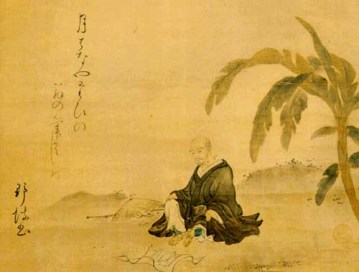
In 17th century Japan, a middling middle-aged poet and scholar moved to a hermit hut. Matsuo Kinsaku had disciples, hangers-on who aspired to fame for his own sake. They bought him a banana-tree for his new quarters.

A banana tree in Japan is an anomaly, having been imported from south China or other warmer climates. The banana tree dies with freezes. In warm months it splays out large leaves with a great green sheen. The poet came to like its great leaves, vulnerable to tearing in the wind but wonderful to listen to the sounds of rain falling on those same leaves.

A banana plant in autumn winds —
I listen to the drops of rain
Fall into a basin at night.

Usually the banana of any variety requires a year of stable temperatures in order to fruit, but in Japan the banana would have died every winter, even late autumn.

When the banana suffers freezing temperatures, its leaves turn brown like overdone leafy vegetables, and at night its leaves curl up like a dead spider. Then the leaves turn black, and its watery trunk can be knocked over with a common garden tool, and that is the end of it. On the surface. But like a flower bulb, the roots will generate a new plant in spring, and by summer, the great splay of leaves can be enjoyed again.

The poet was so enamored of the symbolism and the appearance and the sound that he called himself after the banana, which in Japanese is basho. The poet, of course, was Basho, and his hermit hut was basho-an, the “banana hermitage.” There would be successive huts, as Basho’s poetic skills improved and he took to wandering Japan and seeking out shrines and colorful temples, plodding in the footsteps of the 12th-century poet Saigyo.

Fittingly, a famous portrait of Basho includes a picture of a banana tree.

Giving and getting

Harvest festivals are universal cultural phenomena and to a great degree spontaneous and egalitarian.

But in the United States, observance of a day of thanksgiving separated itself from nature and served a political end. Thanksgiving Day was promulgated by President Lincoln in 1863, in the midst of a civil war the outcome of which was not clear. Lincoln’s proclamation aimed at “healing the wounds of the nation” and restoring it to “God’s purpose,” intending to galvanize the nation into reflecting on an inheritance that might be lost. The character of the holiday was further fortified in another era of war and economic distress in 1941, when President Roosevelt and the Congress fixed the date of Thanksgiving, which was crucial to businesses, which urged an earlier date than the last Thursday of November because Christmas shopping would otherwise be curtailed a week.

The notion of pilgrims and turkeys never entered into the equations of calendars and national unity. And while these mood-setters justify the consumption of myth and meat, the focus has always been on launching the shopping season, a secular Advent running up to the night of gold. The day after, now dubbed Black Friday because the amount of spending puts businesses back into the black, is the official beginning of the month of consumption.

Advice to moderation, and schemes like “Buy Nothing Day” for the day after Thanksgiving, are largely useless when the counterpart to giving (as in “thanks giving”) is getting. The harvest is quickly squandered for getting things, the true confirmation that thanks are warranted to fate or credit-lenders, or to corporations all too happy to service greed and fuel the consumption of items manufactured around the world where there is very little to give or to get. Why should anyone postpone consumption for one day, or exercise moderation, when consumption is not an indulgence or excess but a life-style and moral proof of material ascendancy and cultural superiority? What else can promote the modern life-style except more consumption, gotten from more markets around the world, for more innovations, gadgets, appliances, and collectibles?

Simplicity is not a moderation of greed or even a buy-nothing day. Simplicity is crafting a life around those few material objects that enhance the spirit and promote bodily health, precisely that which traditional harvest festivals celebrated. To give thanks for sufficient clean and healthy food, accouterments, and social conviviality, was the object of such historical fests. But such economies produced only exactly what was needed, and only exactly what uplifted the spirit. That which was gaudy, decadent, or superfluous, was easily identified. Escess and consumption was the providence of the wealthy. Undoubtedly, more modest folk might look upon such excess with envy, but historically it looked upon it as bad. Only today do the modest look upon the wealthy with envy not criticism. Everyone admires them and wants to be like them. Who wants to be simple (it will be argued) when they are too simple as it is? And so the powerful have everyone where they want them.

For the solitary and the spiritually-minded, a constant monitoring of possessions and utilities is an on-going exercise in consciousness. It requires no special day, less an attitude of consumption as a patriotic and mercantile duty to transfer resources from the poor to the rich. That such a duty is prescribed today as economic patriotism, it is because few of us labor at what is important. For that which we need as a minimum for daily life is what we should labor to produce, nothing more. No wonder there arises an alienation assuaged only by consumption.

We should measure our lives by what we can live without, as the Zen saying runs. Modern economics, especially topped by the wealthiest barons of out-sourced industry, offers the opposite dictum. We cannot live contentedly, we will be told, without that vast array of things produced by them. Appealing to the animal instinct for gorging on discovered food, most people are happily led to consume without guilt or reflection, as a new entitlement — manipulated by advertising, media, and corporations. To fill the gaping hole that yawns from the impoverished spirit, we seek to fill it with consuming things, like a starved body willing to take any food or liquid to assuage its pangs of hunger.

In order to get past “getting,” however, one must get past “giving.” Everything is as it is. Our “thanks” for a blue sky or a flower or the patter of rain are nothing more than a projection of our minds outward to embrace that which reflects the moment, reflects a beautiful aspect of existence. Our thanks are irrelevant. Our thanks signify that we are separate from them, that we are in a category that condescends and bestows approval. This giving is a kind of getting in that we are getting pleasure and demanding aesthetic compensation for our gaze, our temperament, our fleeting whim. Hence we get back that satisfaction of a sense of proprietorship, our sense of being both different and better than nature and existence because we have consciousness and can “do” this thanking.

We have set ourselves for the next stage: getting. No wonder Buson, the haiku poet, was even reluctant to cut a flower:

Before the white chrysanthemum
my scissors hesitate
a moment.

If we can question everthing that constitutes “getting,” then we are strengthened to reject the plaudits of consumption, to embrace a simplicity rooted in nature. We cast off the whole cycle of giving and getting, of good and evil, and simply live in harmony with existence as much as possible.

Eremitism & power

What distinguishes the philosophy of eremitism is its rejection of power. But what does it reject?

Power is the ability to act, with whatever ends and in whatever capacity. Power has no inherent moral or ethical basis or content, and is justified a posteriori, after the fact of awareness of its potential. Once aware of itself, power grows insatiably, assuming control over a given sphere of mind, then material conditions. Power is not a force of physics or nature, where no design or ego directs power against others, where forces are innocent of motive and meaning. Only consciousness of its potential — that is, only human beings — can exercise power. Power applies to human and societal uses, and to the vagaries of history and the concentration of power in a class or group over time. The powerful define the basis or content of power — and its uses and legitimacy or moral justification.

Power has been the object of philosophical scrutiny by impartial thinkers hoping to justify the universal use of power by the class of power. But this class of power is not a monolithic entity over time. Power diffuses itself as a human expression and social relationship — over time, geography, culture, and history, over many people in many circumstances.

Power is action and the urging of an effect by the powerful. Regardless of its institutional setting or justification, power contains within itself the corrosive ability to intend an unjust stasis and a justification of necessity, of a necessary condition securing the powerful in their acts. These acts parallel what the powerful will consider natural law. History, then, is the record of the use of power by the powerful.

Power, once enjoyed, once made legitimate, can be renounced in righteous retirement, due to weariness, or tactical withdrawal from a more threatening power. But can power ever really be renounced in itself, rejected wholesale, by a philosophy of life?

Although power is associated with abuse, of its use to exploit, enslave, coerce, or inculcate, power is often presented as freedom, autonomy, and independence. But can even this will to power as benign and nurturing be renounced it itself, rejected altogether for a different frame of mind?

To not act is not merely to reject the desire to be powerful but to reject power as a mode of human relationship with other people or with nature. Eremitism is based on this rejection, not with a sense of criticism or militancy or egoism but as disengagement and detachment, a dismissing of power as a means of living.

Of the many models of eremitism, here are three are suggestive of this disengagement.

The Taoist dictum of wu-wei, “do-nothing,” refers to self-election of separation from social aspiration. Chuang-tzu did not, however, counsel an eremitism that encouraged flight to the mountains. The Taoist philosophical tradition — at least in Chuang-tzu — recommended being a hermit in the crowd, the pursuit of a leisured and contemplative life. Epicureanism in the West is a possible parallel.

But Western eremitism, dealing with more powerful classes of empire culture seeking both political and material control over people and nature, were bound to conflict with authority more directly than in Chinese Taoism or Epicureanism. A philosophical response is found in the life of Diogenes, who rejects social convention as an expression of defiance. Like Chuang-tzu or Epicureans, Diogenes deems life within society as normal. But, whereas Taoists would make themselves inconspicuous, Diogenes — intending to highlight his rejection of power as a philosophy and not merely an affectation — must make his presence in society more flamboyant, more defiant, more public. Decidedly, Diogenes is not a recluse, but like Socrates, is a supreme individualist, eccentrically living a contrived life in order to dedicate himself to his philosophy of life.

Nietzsche’s criticism of Socrates applies as well to Diogenes. Both are caught in an end-of-civilization mode of decadence, and in such circumstances function as reformists, not radicals, as social or legal criminals but not as philosophers. Such is the temptation of resentment, what many disaffected and solitary personalities feel towards society and other people. Resentment engenders reform, the desire to establish a world of social justice, but a reform impossible without power. Resentment cannot be the foundation of a healthy solitude, a proper eremitism that is in harmony with nature and not engaged with society or social issues. This is dramatized by our third example, Poemen.

Poemen was a Christian desert hermit of antiquity. Often ecclesiastical authority retrospectively praised the hermit in order to include this model within religious society. However, the Christian desert hermits decidedly wanted not only be not of the world but not of the world in the Church. Their flight into the desert signified their rejection even of living as hermits in the city, for the city had become the world, and the Church was now in the world. Nor did the desert hermits share either the aplomb of Chuang-tzu nor the self-centered exhibitionism of Diogenes.

Like all eremitisms, the desert hermit version evolved from a deeper, more elusive ethics and psychology. This evolution is presented in a simple, even naive, way in two incidents in the life of Poemen from the narrative of Paschasius. Here is a summary of the incidents:

At this time Poemen lived in a monastery, and a brother who shared his cell was constantly quarreling with another brother. Poemen tried to dissuade the brother from his quarreling but without success. So he went to an elder, saying that he had no peace and asking him what he should do. The elder looked at him and told Poemen that he should lay it into his heart that he was dead, that he was in the grave a year. The elder’s counsel is that disengagement must be so thorough-going that one must be dead to the world, even to the world around us, if we are to gain our peace.

Another incident in later years shows the degree to which Poemen has entered into disengagement: some brothers were arguing vociferously, and Poemen kept his silence. Paphnutius came to him and insisted that Poemen do something. Poemen replied that as they, the quarrelers, were brothers, they eventually would (or at least would have to) reconcile with one another. This answer did not please Paphnutius. But Poemen looked at him and said, “Brother, lay it in your heart that I am not here.”

Was Poemen responsible for resolving the quarrels? For exercising power over others? Can one ever convince anyone of anything using power? Poemen could have used rhetoric, persuasion, pleading — but these are evasions of power, as the powerful themselves will point out. Unsuccessful coercions only reveal weakness and attempts to manipulate; they solve nothing, anymore than does power. For the world’s premise is that power solves problems. Bypassing the consciousness of others, and assuming responsibility for them without understanding their consciousness, their experiences, drives, personalities, and ethics, is the fallacy of using power for anything “good.” And when power is used it is always for “bad.”

Poemen, as an eremitic archetype, found his way to the desert in that great historical exodus from the monasteries. His decision represents an evolution from what one might call the sleight of hand of Chuang-tzu and the societal project of Diogenes.

Eremitism attempts to understand the nature of power because the simplest aspirant hermit senses the inauthenticity of power. Disengagement rather than rejection, renunciation rather than criticism, demurral not acquiescence, self-effacement rather than assertion of ego — these are the foundations of eremitism in antiquity that remain pertinent today.

Issa’s dew

The genius of classical haiku is the transformation of ordinary natural objects into precise expressions of meaning.

Natural objects in themselves have no meaning, of course — they simply “exist.” Human beings assign them meaning — if they are conscious, sensitive, and aware. The poet is conscious, and the culture can serve to promote this exploration of mind and heart. What matters is not that everyone be a poet, but that many appreciate the specialness of the poet’s art. The prerequisite to this appreciation is essentially expressed in the given culture, and here traditional Japanese culture has facilitated this experience for poets.

The object of the haiku becomes not so much a metaphor as a vehicle. In the poem, it does not stand for something (because it has no meaning) but rather evokes emotion and meaning from the human observer. This meaning for the poet is expressed in a universalizing way, linking poet, reader, and, ultimately, the experience of nature. The reader becomes aware of oneness because the successful poet has first felt the awareness, then captured the awareness in a poem, then shared it with a mind on the brink of appreciation and self-transformation. This is the genius of haiku.

The natural objects selected in the “canon” of classical haiku poetry are most representative because their existence is rooted beyond human contrivance. Choosing objects from technology or modern times breaks the sentiment of the poem because it turns itself back on itself, rather than serving as a vehicle, rather than serving to bring nature into harmony with the reader. Thus, from

object --> meaning

we would, with modern or unnatural objects, instead get

contrivance --> object --> contrived meaning

It is the very nature, the very “coming-into-being” of the object that makes the difference.

An example of a natural object is dew. The representative poet is Issa (1763-1828). Issa is considered the sentimentalist of the three great haiku poets, the other two being Basho (the artist) and Buson (the aesthete). The life of Issa was a tragic one. He lost his mother at 3, his father remarried to a hostile woman, Issa’s stepmother, and Issa’s doting grandmother died when he was 14. In adulthood he lost his wife, and all his children died in their youth. When his little daughter died at 2 and a half years — the second or third child to die young — Issa wrote a poem with the header or prescript: “Losing a Beloved Child”:

This dewdrop world
Is a dewdrop —
And yet — and yet —

The dewdrop is a consummate symbol of evanescence and impermanence. The natural object here conveys this sentiment in its very naturalness, its very beingness. Issa would have understood the Buddhist precept, the admonition to detachment from that which does not last, or at any rate, that which does not last long compared to other things — symbolized by dew.

But Issa wonders if that detachment can be possible in this most heart-wrenching situation, the death of a small child. The world is like a dew drop, we are like dew drops, but does that dispense with or thwart love and affection and its corollary sorrow? Does it shield us from emotions? More pressing, Issa wonders: Why do we feel this deep love and compassion and grief for that which will go away? For that which we know consciously (or in repression) will go away? What does nature intend of us? Is the Buddhist admonition true? Is our anguish worse than the hollow comforts of the admonition that does not understand how or what we feel? Such is the weight of Issa’s poem in provoking a whole realm of reflection.

In other poems, Issa uses the image of dew to further explore the sentiment of evanescence.

“I will have nothing more to do
With this sordid world” —
And the dew rolls away.

On the lotus leaf,
The dew of this world
Is distorted.

From the white dew-drops,
Learn the way
To the Pure Land.

In the first poem of these latter three, even the dew recognizes the sorrow of self-consciousness and asserts its philosophy of life — only to roll away, to disappear. Our very attempt to assert our detachment, our disengagement from the “sordid world” is a vanity, for the course of nature itself will surely detach us, regardless of what we think.

For the very evanescence we apprehend is distorted, is too evanescent to disclose reality to us, to reveal to us the mysteries of existence. Perhaps even the lotus, that symbol of wisdom in Eastern tradition, cannot retain the dew in its purest form, cannot serve as a symbolic vehicle for dew.

That is why, in the third poem, Issa suggests that we must learn to not assert anything, to observe quietly, to learn the way from the evanescence we witness around us. For the way does not consist in triumphantly proclaiming that we have learned something, learned anything. Conversely, we must not proclaim that we are ignorant, that we do not know, that we have not fathomed any mysteries. We must be comfortable with this quiet insecurity, this not-knowing. No shame attaches to us as if this not-knowing as if it were a failure of diligence and intellect. Rather, it is that we cannot apprehend , we cannot reason our way into the mysteries of existence. Everything in nature shows us that.

We can explore the depths of this sentiment best in classical haiku. Issa is a good example.

Von Franz on religion

A baseline description of religion is offered by Jungian psychologist Marie-Louise Von Franz in her essay “The Bremen Town Musicians.” Her work on fairy tales and their universality is a trove of ideas and information, and in this essay one finds, almost in passing, this discussion of religion:

The primordial connection of image and instinct … explains the bond between instinct and religion in the widest sense. “Religion” on the most primitive level signifies the psychic regulatory system that relates to the dynamism of the drive.

Religion is the cultural product of human observation of the universe and its wonders, terrors, mysteries, sources of fear, recognition of cycles (birth and death, seasons, light and dark, etc.). Consciousness brings these observations directly into the instincts and emotions, into the psyche.

These images or impressions evoke seamless functionality in animals, what we call instinct. Little regulation is needed, and thus we wonder at how little instruction a newborn animal requires from its mother. Not so the human being, whose consciousness quickly opens the gulf between image or instinct, and mind, reflection, and consciousness. The wonder at the environment and self become layers of conflicting emotions, products of the interaction taken by us and sifted by the mind to make a meaningful narrative of reality.

This search for meaning is only a search for harmony with this environment, a search to reconcile mind and instinct. But as environment grows complex, the tools of the mind are easily outstripped. Positive socialization can help guide a child to harmony. The fairy tales present to children essential images, symbols, and emotional undercurrents. They make order out of environment and universe without heavy-handedness. Would that fairy tales were in every child’s hands!

Religion means the “psychic regulatory system” in this very basic sense of providing a child with social and mental images and emotional experiences that will allow the child to prosper, to allow the child to achieve the tools for reconciliation, for harmony of self and environment. Von Franz wisely begins at the beginning, as do Jungian and other psychological schools, in accounting for the functions of the mind, and looking to psychic harmony as the tacit aspiration of the self.

Extrapolating, then, one might say that “religion” is successful to the degree that it services the regulatory function of the psyche. Jung identified the archetypes that reflect pivotal aspects of universal thought and sentiment specifically as points of encounter for the self in the quest for harmony. Failing to incorporate within the psyche these pivotal points, these bundles of psychic energy, results in neuroses, or worse. Adjusting to society is not the goal of Jungian psychology, it is self-actualization, self-realization, which in turn allows the individual to rightly place environment and emotions into their right context, their regulated context. This process, and its final product, is a form of primordial “religion.”

In civilizations, chaos arises when the energies represented by the archetypes are ignored, subverted, overthrown, denied, assaulted, or dismissed. This is not to say that there is never a universal “discontent” with civilization but crafty and worldly-wise rulers give their populace surrogate symbols on which to masticate. In the full sense of civilization or culture, the collective structures, the outward constructs of power and authority, fail to reconcile the least sensitive individuals to their selfhood. The goal is, rather, to reconcile the individuals to the structures. By society’s standards, failing that reconciliation means alienation, and the regulatory function is itself alienating and injurious. The regulatory function, however, is then false or traitorous, for it no longer intends to reconcile environment and self, instinct and mind. Thus Von Franz continues:

On the higher level, to be sure, this primordial bond is often lost, and then religion easily becomes a poison counteracting the drive, and in this way the original relationship of mutual compensation degenerates into the well-known conflict between mind and instinct.

Note that the conflict is brought about by the artificial imposition of a system that would disrupt the harmony within, yet promote an outward harmony. All children will experience conflict with parents, peers, other adults, authority figures beyond their circle. This will be part of the inevitable maturation process. At each point, these conflictors can conceivably serve to promote inner harmony rather than exacerbate conflict. But competition, rivalry, jealousy — in short, survival instincts — will thow consciousness into conflict with instincts, and the primordial drives will be channeled not into creativity but into conflict with others, let alone with self. The individual will have to become neurotic in order to become socially functional. Von Franz describes all this briefly:

Initially of course people degenerate and fall into conflict with their true nature. They forget their origins, and their consciousness behaves in an autocratic manner that is antagonistic to the instincts.

But somehow we survive childhood, and bear with society. For the conflict, the split between mind and instinct, is not absolute, Von Franz notes:

Such a split is by no means just an accident and a senseless catastrophe; rather it contributes toward the broadening and further differentiation of human consciousness. In other words, if the conflict reaches a certain unbearable intensity, the unconscious instigates a new reconciliation between instinct and mind by producing symbols that reconcile the opposites.

And herein lies the genius of the fairy tale — and “fairy tales” for adults as literary, visual, and aural art. The fairy tale presents us with constant conflict of epochal dimensions — or apparently mundane dimensions made complex by instincts — and brings us refreshing symbols to absorb and concentrate the energies of the given conflict. The reader or listener can then address not the conflict but the symbol, not the dysfunction but the harmony, not the tenets of a “religion” but the psychic regulatory function that only the symbols provide. The symbols are receptacles of primordial and complex emotions and instincts. They constitute “civilization” in its best sense.

Fairy tales, like dreams, are beyond logical deconstruction. Logical arts are in this realm not efficacious. “Religion” is a psychical function that projects consciousness to its furthest extension while safeguarding the weakness within of mind and thought and emotion. If we find our “way” successfully through what is represented as archetypes, what is projected by our psyche as essential symbols, then the externals of “religion” ultimately withdraw themselves, not longer needed, like the finger pointing to the moon.

Wabi-sabi house

Wabi and sabi are, strictly speaking, aesthetic principles, but because ultimately they originate in the aesthetic experience of the Japanese hermits, these principles confirm a given philosophy of life as clearly as does any other likely correspondence between a way of life, a philosophy, and an aesthetic sensibility.

Wabi and sabi have a formal or definitional understanding (touched upon in a 2004 Hermitary article: http://www.hermitary.com/solitude/wabisabi.html — one of the most popular articles on the site, by the way). A technical understanding is a prerequisite to an aesthetics of solitude. However, the application of wabi-sabi outside of the specific Japanese arts of poetry, tea ceremony, gardening, etc., is not easy for anyone without a specific skill and aesthetic taste. One may admire from afar but dare not attempt to mimic the effect.

At least one can drill down from the principles to practical applications in one’s daily life. A 2004 book by American writer Robyn Griggs Lawrence is a successful popularization of the complexities and nuances of wabi-sabi. The book offers practical suggestions with a warm and and a worldly-wise tone that encourages the possible: The Wabi-sabi House: the Japanese Art of Imperfect Beauty, by Robyn Griggs Lawrence.

Here is the very useful table from Lawrence to correspond with the more technical one in the Hermitary article. These principles can be put to good use in one’s immediate surroundings.

wabi-sabi is … wabi-sabi isn’t …
dry leaves cherry blossoms
bare branches floral arrangements
handmade machine made
weathered wood plastic laminate
crumbling stone polished marble
wildflowers roses
wool polyester
rice paper plate glass
clay china
unbleached cotton cashmere
tea latte
vintage designer
cobblestones concrete
adobe steel
arts and crafts rococo
flea markets warehouse stores
salvaged made to order
burlap velvet
oil finish polyurethane
recycled glass crystal
native landscaping kentucky bluegrass
natural linoleum vinyl
hemp silk
clean cluttered
frank lloyd wright ludwig mies van der rohe
natural plaster drywall
natural light fluorescent light
clthoeslines electric dryers
handmixers food processors
rust dirt


Nietzsche’s Jesus

Nietzsche is identified as the arch-atheist of the culminating 19th century, the prophet of the Death of God and of Christianity. Like like many thinkers, Nietzsche described what he saw and what influenced him. Thus his reflections on Jesus are remarkably mild, remarkably positive.

Atheism is neither relevant nor contributory to this process, working to demolish rather than to understand. Nietzsche’s “philosophizing with a hammer” (the subtitle of Twilight of the Idols is “How to Philosophize with a Hammer”) is also an exaggeration, as his translator Walter Kaufmann points out. Nietzsche isn’t demolishing anything; he taps each idol to discover if it hollow.

In the 20th century, the demythologizing of Jesus begun in the Enlightenment culminated in the “historical Jesus” movement. The archaeological discoveries of the Nag Hammadi and Dead Sea documents and apocryphal writings, plus the rise of exegesis and content criticism largely confirm the consensus about the historical Jesus. Also relevant was the rise of knowledge about Eastern thought that would provide a context to universal ideas.

Here are a couple of examples. Already in the mid-18th century, the deist Thomas Jefferson had written:

To the corruptions of Christianity I am indeed opposed, but not to the genuine precepts of Jesus himself. I am a Christian, in the only sense in which he wished anyone to be: sincerely attached to his doctrines in preference to all others, ascribing to himself every human excellence, and believing he never claimed any other.

By doctrines, Jefferson makes clear that he refers to the virtues and ethics Jesus taught. And in the 19th century, French writer Ernst Renan says in his biography of Jesus:

Never has anyone been less a priest than Jesus, never a greater enemy of form, which stifles religion under the pretext of protecting it. By this, we are all his disciples and his successors; by this he has laid the eternal foundation stone of true religion; and if religion is essential to humanity, he has by this deserved the divine rank the world has accorded to him. An absolutely new idea, the idea of a worship founded on purity of heart, and on human brotherhood, through him entered into the world — an idea so elevated that the Christian Church ought to make it its distinguishing feature, but an idea which in our days only few minds are capable of embodying …

Whatever may be the transformation of dogma, Jesus will ever be the creator of pure religion; the Sermon on the Mount will never be surpassed. Whatever revolution takes place will not prevent us from attaching ourselves in religion to the grand intellectual and moral line at the head of which shines the name of Jesus. In this sense, we are Christian, even if we separate ourselves on almost all points from the Christian tradition which has preceded us.

Although he thought Renan too romantic, Nietzsche was equally interested in a human and humane Jesus rather than in a refined secularization of Jesus. He essentially salvages the core values of what can now be linked to Eastern thought in general and religious thought universally. These values are not so much ethics as a method or philosophy of how to live.

Nietzsche’s portrayal of the historical Jesus is startlingly at odds with the anti-Christian bombast of many predecessors, including much of his own work and specifically The Antichrist and Twilight of the Idols, where his most delicate passages on Jesus are found. Kaufmann notes that Antichrist could better be titled Antichristian, referring to the institutional “Christian” as his chief opponent, the adherent to authority, using the pointed vocabulary of slave morality in his exploration of the genealogy of Western morals.

Like earlier philosophers, Nietzsche rescues Jesus from both Judaism and Christianity. Nietzsche’s exceptionalism rescues Jesus as much from the atheists as well. This is because Nietzsche detects in Jesus not a dreamer, an idealist, a magiciana or a fraud (as do atheists) but a philosopher, and, therefore, a kindred spirit. The parallel is to Zarathustra, a philosopher misunderstood by the masses, offering a message doomed to fall on deaf ears, if not to be distorted for a nefarious purpose. Jesus is, like Nietzsche’s alter-ego Zarathustra, a “hermit” philosopher.

If I understand anything at all about this great symbolist, it is this: that he regarded only subjective realities as realities, as “truths” — that he saw everything else, everything natural, temporal, spatial and historical, merely as signs, as materials for parables. The concept of “the son of God” does not connote a concrete person in history, an isolated and definite individual, but an “eternal” fact, a psychological symbol set free from the concept of time. The same thing applies, and in the highest sense, to the God of this typical symbolist, of the “kingdom of God,” and of the “sonship of God.”

Nothing could be more unchristian than the crude ecclesiastical notions of God as a person, of a “kingdom of God” that is to come, of a “kingdom of heaven” beyond, and of a “son of God” as the second person of the Trinity. All this — if I may be forgiven the phrase — is like thrusting one’s fist into the eye (and what an eye!) of the gospels: a disrespect for symbols amounting to world-historical cynicism.

The “kingdom of heaven” is a state of the heart — not something to come “beyond the world” or “after death.” The whole idea of natural death is absent from the gospels: death is not a bridge, not a passing; it is absent because it belongs to a quite different, a merely apparent world, useful only as a symbol. The “hour of death” is not a Christian idea — “hours,” time, the physical life and its crises have no existence for the bearer of “glad tidings.”

The “kingdom of heaven” is not something that people wait for: it had no yesterday and no day after tomorrow; it is not going to come at a “millennium” — it is an experience of the heart, it is everywhere and it is nowhere.

This “bearer of glad tidings” died as he lived and taught — not to “save mankind,” but to show mankind how to live. It was a way of life that he bequeathed to man: his demeanor before the judges, before the officers, before his accusers — his behavior on the cross. He does not resist; he does not defend his rights; he makes no effort to ward off the most extreme penalty. On the contrary, he provokes it. And he begs, he suffers and he loves with those, in those, who do him evil. Not to defend one’s self, not to show anger, not to blame others. On the contrary, to submit even to the evil one — to love him, was nothing other than this practice — nor was his death anything else. The deep instinct for how one must live, in order to feel oneself “in heaven,” to feel “eternal,” while in all other behavior one decidedly does not feel oneself “in heaven” — this alone is the psychological reality of “redemption.” A new way of life, not a new faith.

These passages from The Antichrist, 33-35, place the historical Jesus with the sages of the East and the philosophers of life in the West. The concept of living in the present has become hackneyed and abused today, but the historical Jesus assembling common people to understand and practice the values of community are timeless. Together, the wise and the simple could order their lives into a kingdom of heaven would they but heed the sages.

This is not to say, of course, that Nietzsche was innocent of great bluster and belligerence, but those who claim that Nietzsche’s last ideas and works (published posthumously) were beset by insanity have only to read these passages on Jesus to know that Nietzsche was, on the contrary, in this instance, generous and soulful, striving for some personal accord that he would, however, never attain.